That clause is the recapture provision.
Most dealers who sell vehicle service contracts, GAP, or ancillary F&I products have reinsurance exposure they've never fully examined. This article explains what recapture provisions are, what sets them off, what actually happens when one gets triggered, and why program structure matters far more than most dealers realize until it's too late.
TL;DR
- A recapture provision lets the ceding party (insurer) take back risk previously transferred to a reinsurer—voluntarily or involuntarily
- Triggers include reinsurer default, credit rating downgrades, regulatory changes, and voluntary business decisions
- Recapture shifts open claims, reserves, and all administrative obligations back to the ceding party—immediately
- Contract language that's vague or one-sided creates hidden risk that only surfaces during a crisis
- Dealer-owned reinsurance eliminates third-party counterparty default risk—dealers retain premiums, claims authority, and program assets
What Is a Recapture Provision in Reinsurance?
A recapture provision is a clause in a reinsurance treaty that allows the ceding party—the insurer who originally transferred risk—to take back some or all of the risk previously ceded to the reinsurer. The Society of Actuaries defines these provisions as clauses that "define either an obligation or an option for the cedant to take back business at a specific point in time or over a defined period," carrying "significant financial implications for all involved parties."
The Three Key Parties
| Party | Role |
|---|---|
| Ceding Company | The primary insurer that transfers risk. In dealer F&I, this is typically the warranty company or program administrator |
| Reinsurer | Accepts the transferred risk in exchange for a share of premiums |
| Contract Holder | The dealership customer whose VSC, GAP, or ancillary product is backed by this arrangement |
How This Plays Out in F&I
When a dealer sells a vehicle service contract or GAP product through a third-party provider, that provider typically cedes a portion of the risk to a reinsurer. The dealer captures a gross profit at point of sale, but the underwriting profit that accumulates as contracts expire flows to the provider and reinsurer. The recapture provision governs what happens when that arrangement unwinds.
There are two distinct types:
- Voluntary recapture — the ceding party elects to take back risk, usually because their financial position has strengthened or they want to retain more profit
- Involuntary recapture — forced by a failure, default, or contract breach, often returning risk at the worst possible time
Understanding which type applies — and when — shapes how much negotiating leverage any party holds. Recapture provisions are standard in most reinsurance treaties, but the SOA notes that older contracts often included recapture options "given away for free," while modern contracts recognize recapture as "an option with associated costs." That distinction determines whether a dealer has any practical ability to exit an arrangement on favorable terms, or whether they're locked into a structure that no longer serves them.
When and Why Recapture Gets Triggered
Recapture triggers fall into two categories: voluntary exits a dealer controls, and involuntary ones that activate based on the reinsurer's financial condition or regulatory standing. Knowing which scenario you're in—before it happens—shapes how much leverage you actually have.
Voluntary Triggers
A dealer or ceding insurer may choose to invoke recapture when:
- The business has grown and the dealer wants to retain more underwriting profit
- The reinsurer raises rates on an unprofitable block of business
- Strategic direction shifts and a new program structure better fits the dealer's goals
- The reinsurer undergoes a change of control that changes the relationship
In this scenario, the dealer holds the leverage. That changes significantly when the trigger isn't voluntary.
Involuntary Triggers
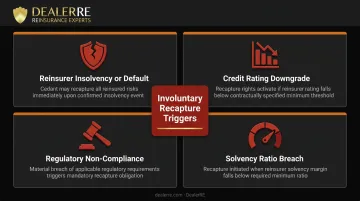
Involuntary triggers are more consequential because they're initiated by the reinsurer's failure, not the dealer's choice — and they carry immediate financial exposure:
- Reinsurer insolvency or default: The risk reverts to the ceding party. Any unpaid claims or unfunded liabilities become the ceding company's problem.
- Credit rating downgrade: The American Academy of Actuaries confirms that many treaties include "enhanced recapture rights following changes in reinsurer capital or financial ratios, reinsurer downgrade, change in control, and insolvency."
- Regulatory non-compliance: Under the NAIC Credit for Reinsurance Model Law, if a reinsurer loses its qualifying status, the ceding insurer may lose the ability to take reinsurance credit—effectively forcing recapture or restructuring.
- Solvency ratio breach: Treaties often include early warning thresholds tied to a reinsurer's Risk-Based Capital (RBC) ratio. Cross that line, and recapture rights activate.
Notice Requirements and Exit Costs
Voluntary recapture rarely means walking away immediately. Most contracts impose:
- Minimum retention periods before voluntary recapture is permitted
- Advance notice requirements, typically 90–180 days (an SEC-filed RGA reinsurance agreement confirms a 90-day standard)
- Recapture fees that compensate the reinsurer for expected future profits it will no longer receive
The SOA notes that fee structures can be tiered—fees may apply at moderate rating drops but be waived if the trigger is insolvency-level. That distinction matters: review your treaty language now, before a trigger event, to confirm which protections are actually built in.
What Actually Happens When Reinsurance Is Recaptured
The practical reality of recapture is more disruptive than most dealers expect—especially in an involuntary scenario.
Immediate Obligations
Once risk is returned to the ceding party, that party becomes responsible for:
- Covering all open claims on recaptured policies
- Posting capital or reserves to support the recaptured book of business
- Taking on all investment assets (or shortfalls) that were backing the reinsured contracts
- Managing all administrative obligations for active policies
RGA's guidance confirms this clearly: upon recapture, the insurer must "cover any financial losses, post risk capital to support recaptured liabilities, and find replacement reinsurance."
What Dealers' Customers Experience
Service contract holders and GAP customers whose coverage was backed by the recaptured reinsurance can experience claims delays during a transition. For a dealership, that means customer complaints and reputational damage from a problem the dealer technically inherited rather than caused.
Why Troubled Recaptures Take Years to Resolve
Troubled recaptures don't resolve quickly. The SOA documents a case where a reinsurer under regulatory management was "forcing ceding companies to pay premiums but was not reimbursing death claims". In that scenario, recapture provisions offered no practical relief—only rights that couldn't be enforced.
Mayer Brown puts it plainly: "Insurers must be able to demonstrate that they would remain viable in the event of a recapture, whether from a single counterparty failure or from multiple simultaneous recaptures."
Most small ceding parties—including warranty program administrators with dealer exposure—cannot make that demonstration easily.

The Hidden Risks Most Dealers Don't See Coming
Most dealers encounter these risks not because they ignored the fine print, but because the problems are baked into structures that look standard until they aren't.
Counterparty Concentration
Many dealers route all of their reinsured F&I risk through a single third-party provider without giving it much thought. AM Best identifies counterparty concentration risk as a primary factor in evaluating reinsurance recoverables—and the risk compounds when all exposure sits with one entity. If that entity weakens, there's no diversification to absorb the impact.
The Snowball Problem
The SOA identifies a second layer of systemic risk: if multiple reinsurance treaties with the same reinsurer contain identical financial trigger clauses, a single breach event can cascade. "The presence of such options in numerous treaties could potentially lead to a snowball effect or even a downgrade for a reinsurer if a trigger is breached."
In other words, recapture rights in concentrated books can accelerate a reinsurer's deterioration rather than protect against it.
Recapture Rights That Disappear When You Need Them
The SOA documents that "in cases where a reinsurance company becomes insolvent, any associated recapture right may largely lose its value." The contractual protection is weakest precisely when the threat is greatest.
The AAA puts the underlying principle plainly: "Reinsurance is only as valuable as the ability to collect claims from a reinsurer when a loss event occurs."
Vague Contract Language
The SOA urges parties to "spend extra time to ensure treaty language is clear and effective for the long term." Vague definitions of key terms—"retention," "change in control," "material adverse change"—create ambiguity that disadvantages dealers when disputes arise. Reviewing these definitions before signing—not after a dispute surfaces—is where that risk is actually managed.
How Dealer-Owned Reinsurance Changes the Recapture Equation
The structure of a reinsurance program determines most of the recapture risk — and that structure looks fundamentally different in a dealer-owned model.
The Core Difference
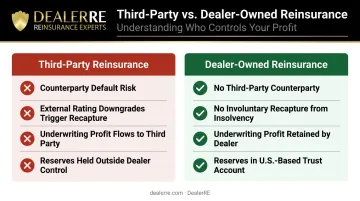
In a dealer-owned reinsurance model using an admin obligor structure, the dealer's own company is the reinsurer. Rather than ceding risk to an unrelated third party, the dealer captures underwriting profit directly within an entity they own and control. There is no third-party counterparty to default. The reinsurer insolvency trigger—the most dangerous involuntary recapture scenario—is simply not a factor.
DealerRE has been structuring these programs since 1994, using A-rated insurers as the fronting (backing) layer. An A-rated carrier issues the policy and then cedes risk to the dealer's captive, providing consumer protection and regulatory compliance without requiring the dealer to surrender profit or control.
What This Eliminates
With dealer-owned reinsurance:
- No third party accumulates underwriting profit at the dealer's expense
- Counterparty solvency risk cannot trigger involuntary recapture
- No external rating agency downgrade can activate an unwanted recapture clause
- Reserves stay in a U.S.-based trust account, controlled by the program agreement
What Still Requires Attention
Voluntary recapture provisions still exist even in dealer-owned structures. If a dealer ever wants to wind down their reinsurance company or transition programs, the exit terms matter. Dealers should work with experienced program administrators who understand these provisions and can structure them favorably from the start, rather than trying to negotiate better terms under pressure after the fact.
Key Contract Provisions Every Dealer Should Review
Before signing any reinsurance agreement—whether third-party or dealer-owned—these terms deserve specific attention:
Recapture-specific provisions to verify:
- How long must you hold the arrangement before voluntary recapture is permitted?
- How much lead time is required for notice, and what form must it take?
- Is there a recapture fee? How is it calculated, and is it waived under trigger conditions such as insolvency?
- What specific events activate forced recapture, and are those thresholds clearly defined?
Structural provisions only tell part of the story. The financial terms are where ambiguity creates real exposure.
Financial terms that must be explicit:
- What happens to unearned premiums at the time of recapture?
- How are open claims handled—and who funds them during transition?
- What reserve requirements apply to the ceding party upon recapture?
The SOA recommends that "if recapture is elected, the entire eligible block of business must be recaptured" to prevent cherry-picking by either party. If your contract doesn't address anti-selection, push for it.
Never sign a reinsurance contract without an experienced advisor reviewing the recapture provisions specifically. Vague notice requirements, undefined trigger thresholds, and silent anti-selection clauses are the terms most likely to create costly disputes later. DealerRE reviews these provisions as part of every program evaluation—helping dealers understand exactly what they're agreeing to before they sign.