Federal Reserve data from May 2026 shows BHPH loan balances have grown 214% since 2018, meaning the portfolio risk attached to each unresolved dispute is compounding. With over 50% of BHPH loans going to deep subprime borrowers, customers are already under financial pressure — any post-sale mechanical surprise can escalate quickly.
The good news: most disputes aren't caused by bad faith. They stem from unclear warranty language, missing documentation, and no defined resolution process — all fixable before a dispute ever starts.
This article covers the root causes of BHPH warranty disputes, how to document terms clearly, a step-by-step resolution process, when to escalate to arbitration, and how dealer-owned reinsurance eliminates the structural conditions that make disputes likely.
TL;DR
- Most BHPH warranty disputes trace back to ambiguous contract language and missing documentation, not customer fraud
- A written limited warranty addendum with a specific component list and integration clause prevents most disputes at the source
- A defined five-step internal review process resolves most claims before any escalation is needed
- Arbitration clauses in sale contracts provide a faster, lower-cost alternative to civil court for unresolved disputes
- Dealer-owned reinsurance programs, like those DealerRE builds for BHPH dealers, keep claims authority in-house and cut out the third-party denials that trigger most disputes
Common Triggers Behind BHPH Warranty Claim Disputes
Most warranty disputes don't start with a bad-faith customer. They start with a documentation gap.
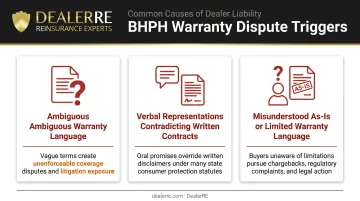
The Three Most Frequent Dispute Triggers
- Ambiguous warranty language — "Powertrain only" without a named component list invites disagreement. If the transmission isn't explicitly listed, the customer will assume it's covered — and that assumption becomes a dispute.
- Verbal representations that contradict written contracts — A salesperson who says "don't worry, we'll take care of it" creates an implied obligation the written contract may not support. Courts in several states allow verbal promises to override "as is" clauses when no integration clause is present.
- Misunderstood "as is" or "limited warranty" language — BHPH buyers often have limited automotive knowledge and signed under financial pressure. The gap between what they believe they purchased and what the contract says is wider in this segment than almost anywhere else.
Why the Expectation Gap Is Widest in BHPH
CFPB research consistently shows BHPH buyers are disproportionately deep subprime — already stretched thin financially. When a $400/month payment is a real burden and the vehicle breaks down in month two, the customer isn't just frustrated. They're actively looking for a contractual basis to dispute the claim or stop payment.
That reality makes over-communicating warranty scope in writing not just good practice — it's a collections strategy.
Regulatory Exposure Dealers Can't Ignore
A pattern of warranty complaints — even individually dismissed ones — can draw attention from regulators. The CFPB's first enforcement action against a BHPH dealer resulted in an $8 million civil money penalty against DriveTime in 2014. State attorneys general have increasingly built "mini-CFPB" units focused on subprime auto finance. Neither agency needs a warranty-specific violation to open an investigation — a complaint pattern is enough.
Laying the Foundation: Warranty Documentation That Prevents Disputes
The best dispute resolution process is the one you never have to use. Most BHPH warranty disputes are preventable with the right documentation at the point of sale.
The Written Limited Warranty Addendum
A vehicle-specific limited warranty addendum — separate from the purchase contract — is the most effective dispute prevention tool available. It should include:
- Named covered components (not categories like "powertrain" — list the actual parts)
- Warranty period defined in days and miles, whichever comes first (e.g., 30 days/1,000 miles)
- Dealer's cost-share percentage for parts and labor
- Explicit exclusions covering wear items, misuse, and pre-disclosed conditions
- An integration clause stating the written agreement is the complete warranty understanding between parties
The integration clause matters more than most dealers realize. Without it, a customer's attorney can argue that verbal promises made during the sale modified the written terms. Without that clause, courts in several states have admitted outside verbal testimony — known as parol evidence — to override written "as is" language entirely.
Pre-Sale Vehicle Condition Disclosure
Before handing over keys, every known defect, wear item, and "as is" component should be documented on a signed inspection checklist. This single document does two things:
- Eliminates ambiguity about what was disclosed vs. what appeared post-sale
- Demonstrates good-faith compliance with the FTC Used Car Rule, which requires Buyers Guide disclosure on every used vehicle offered for sale
That compliance exposure is real: each FTC Used Car Rule violation carries civil penalties of up to $51,744 per violation. A signed checklist costs nothing compared to that risk.
Training Staff on Verbal Promise Liability
Sales and F&I staff should be trained on one clear rule: all warranty questions get directed to the written contract. No verbal representations about vehicle condition, no informal commitments after the close. Document any customer concern in writing and reference the applicable warranty term.
That paper trail is the dealer's primary defense if a customer later claims an oral promise was made.
Seven States Where "As Is" Won't Protect You
Dealers operating in DC, Kansas, Maryland, Massachusetts, Mississippi, Washington, or West Virginia cannot disclaim implied warranties in consumer transactions regardless of what the Buyers Guide states. Minnesota mandates tiered warranty coverage based on vehicle mileage. Dealers in these jurisdictions need written limited warranties — not "as is" stickers — as their baseline protection.
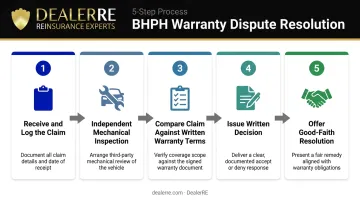
A Step-by-Step Process to Resolve BHPH Warranty Claim Disputes
When a dispute does arise, a defined internal process resolves the majority of claims before they escalate.
Step 1 — Receive and Log the Claim
Every warranty complaint needs a written record the moment it's received. Capture:
- Date received
- Customer name and contact information
- Vehicle VIN and current mileage
- Stated issue in the customer's own words
Oral complaints handled informally are a documentation liability. Convert every complaint to a written record before taking any action.
Step 2 — Conduct an Independent Mechanical Inspection
Require the customer to bring the vehicle in for a dealer-arranged inspection by a qualified mechanic. The inspection should produce a written report that:
- Identifies the specific mechanical failure
- References the original warranty terms
- Notes the mileage at the time of inspection
- Compares findings against the pre-sale inspection checklist
This inspection is your factual foundation. Without it, any coverage decision becomes a word-against-word dispute.
Step 3 — Compare the Claim Against Written Warranty Terms
Map the reported defect to the covered components list in the warranty addendum. Specifically check:
- Is the failed component named in the coverage list?
- Did the failure occur within the defined period and mileage?
- Was the failure caused by customer misuse or a pre-disclosed condition?
- Does any exclusion apply?
This step should be formal and documented — not a quick judgment call.
Step 4 — Issue a Written Decision
Every claim outcome — approval, partial approval, or denial — must be communicated in writing. The written decision should cite the specific warranty term that supports it.
A well-documented denial that references the contract is far harder to dispute than a verbal rejection — and gives you a defensible record if the customer escalates to the CFPB or a state AG.
Step 5 — Offer a Good-Faith Resolution When Appropriate
The contractual answer is sometimes "denied," but the business decision isn't always that simple. Consider a partial repair contribution when:
- Coverage falls in a borderline or ambiguous situation
- The customer maintains a strong payment history
- Retaining the customer costs less than the repair itself
Document any goodwill contribution explicitly as a gesture that does not constitute an admission of liability or a precedent for future claims. This protects the dealer while preserving the relationship.
Arbitration and Mediation: When to Escalate Beyond the Dealership
When internal resolution fails, dealers need a faster path than civil court.
Why Arbitration Clauses Belong in Every BHPH Sale Contract
A mandatory arbitration clause routes unresolved disputes to a private hearing process instead of the court system. The advantages for BHPH dealers are concrete:
- Eliminates the need for legal counsel on every small claim
- Reduces exposure to outsized jury awards
- Produces an enforceable decision in a fraction of the time of litigation
Under AAA Consumer Arbitration Rules, the consumer filing fee is capped at $200, with the dealer bearing remaining administrative costs — keeping the process accessible while moving far faster than courts.
These benefits only hold if the clause is enforceable. The California Supreme Court upheld standard auto sale arbitration clauses in Sanchez v. Valencia Holding Co. by a 6-1 majority in 2015, and the Federal Arbitration Act preempts state rules specifically targeting class waivers.
Mediation vs. Arbitration: Choosing the Right Path
| Option | Outcome | Best For |
|---|---|---|
| Mediation | Non-binding; facilitated negotiation | Lower-dollar claims where the customer relationship still has value |
| Binding Arbitration | Enforceable decision | Claims requiring a definitive resolution |
A practical rule: if the dispute involves a repeat buyer or a straightforward repair disagreement, mediation often resolves it faster and cheaper. Reserve arbitration for claims where a definitive outcome is needed and informal resolution has stalled.
Whichever path you choose, the clause must be clearly disclosed in the sale contract — not buried in fine print — and ideally acknowledged separately by the buyer. Have legal counsel review it for state-specific enforceability requirements before it's ever needed.
How Dealer-Owned Reinsurance Gives BHPH Dealers Direct Control Over Claims
Most BHPH warranty disputes that escalate to formal complaints share a common origin: a third-party warranty company denied or minimized a claim the customer believed was legitimate.
The Structural Problem With Third-Party Providers
When a BHPH dealer relies on a third-party warranty administrator, claim decisions are made by an entity whose financial incentive is to minimize payouts — not to protect the dealer's customer relationships or loan performance. The dealer takes the customer complaint, absorbs the reputational damage, and has no control over the outcome.
This creates disputes the dealer didn't cause and can't resolve.
How Dealer-Owned Reinsurance Changes the Equation
In a dealer-owned admin obligor reinsurance structure, the dealer's own reinsurance company funds and administers warranty claims. Claim decisions are made by the entity with the most to gain from customer satisfaction — the dealer.
DealerRE has been building and managing admin obligor reinsurance programs for BHPH dealers since 1994. Their programs are structured so that:
- Premiums are financed over the loan term, with monthly billing as customer payments come in — preserving cash flow
- Claims are paid from the customer-funded premium pool, with A-rated insurer backing as a financial safety net
- Full claims adjudication support is provided through their administration partner, keeping the process operationally manageable for the dealer
As DealerRE describes it, the structure allows BHPH dealers to "pay your customer's claims, and not other dealers'." When a car breaks down, the dealer can dip into the customer-funded pool to cover the repair — keeping the customer on the road and on their payment schedule.
The Downstream Effect on Dispute Frequency
When dealers control claims outcomes, the conditions that generate disputes disappear:
- Legitimate claims get approved based on relationship value, not underwriter margin
- Response times shrink because the dealer controls the process end-to-end
- Coverage questions get answered directly — the dealer owns the product and can explain it without routing through a third party
The dispute resolution process described earlier shifts from reactive to preventive. Most claims resolve in the early steps — before a customer complaint has any reason to escalate.
Frequently Asked Questions
How do I dispute a BHPH dealer warranty claim?
Review the written warranty terms against the complaint, conduct a documented mechanical inspection, and issue a written decision citing specific contract language. If the dispute isn't resolved internally, escalate to mediation or arbitration as outlined in the sale contract.
What should be included in a BHPH limited warranty contract?
A BHPH limited warranty should include a specific list of covered components by name, the warranty period in days and miles (whichever comes first), the dealer's cost-share percentage for parts and labor, explicit exclusions, and an integration clause stating the written agreement is the complete warranty.
Can a BHPH dealer sell a car "as is" and deny all warranty claims?
Not always. Seven jurisdictions prohibit "as is" consumer sales entirely, and courts in many states recognize implied warranties even with proper disclosures. The Magnuson-Moss Warranty Act also limits implied warranty disclaimers whenever any written warranty is provided.
What happens if a BHPH customer files a complaint with the CFPB or state attorney general?
The CFPB forwards complaints directly to the dealership and expects a response within 15 days. Dealers with thorough written documentation and a clear internal resolution process are in the strongest position to respond quickly and avoid escalation.
Is arbitration enforceable in BHPH sale contracts?
Generally yes. Arbitration clauses are enforceable under the Federal Arbitration Act, as confirmed by both California and New Jersey Supreme Courts. The clause must be clearly disclosed — not buried in fine print — and ideally acknowledged separately by the buyer, with legal counsel confirming your state's specific requirements.
How does dealer-owned reinsurance reduce warranty claim disputes?
Dealer-owned reinsurance transfers claims review and approval from a third-party provider to the dealer's own reinsurance company. The dealer can approve legitimate claims faster, communicate coverage decisions directly, and eliminate third-party denials — the single biggest trigger for formal customer disputes. DealerRE helps BHPH dealers build these programs specifically to keep claims control in-house.