That's not a coincidence. Reinsurance offers something most industries don't: genuine intellectual depth, strong compensation, and long-term career stability that rewards people who build real expertise rather than just filling seats.
This article covers two distinct tracks. First, traditional reinsurance careers — actuarial, underwriting, claims, account management — with honest data on what they pay and how to break in. Second, a niche that doesn't get nearly enough attention: dealer-owned reinsurance, where auto dealers operate their own reinsurance companies to capture F&I profits they'd otherwise hand to third parties. Both tracks are legitimate, well-compensated, and growing.
TLDR
- Reinsurance careers offer strong pay, intellectual challenge, and long-term stability across multiple specializations
- Actuaries in reinsurance earn a $125,770 median salary with 22% projected job growth through 2034
- Dealer-owned reinsurance lets auto dealers retain 100% of underwriting profits from F&I products instead of sending them to third-party providers
- F&I experience from a dealership is a direct entry point into dealer reinsurance consulting and account management
- ARe and CPCU designations provide structured entry pathways for candidates with finance, risk, or insurance backgrounds
What Is Reinsurance and Why Does It Matter?
Reinsurance is insurance for insurance companies. A primary insurer collects premiums and takes on risk from policyholders. To avoid catastrophic exposure — think hurricane season or a single massive industrial loss — that insurer transfers a portion of its risk to a reinsurer. The NAIC describes it as a contract where the cedent transfers risk and the reinsurer assumes all or part of the policies issued.
Without reinsurance, insurance companies couldn't write policies at the scale modern economies require. The stability of almost every major insurance product — home, auto, commercial, life — depends on it operating in the background.
Two Flavors Worth Knowing
- Treaty reinsurance covers broad portfolios automatically — a pre-agreed arrangement that kicks in across an entire book of business
- Facultative reinsurance covers specific, individual risks case-by-case, often for unusual or high-value exposures
These two structures define workflows across underwriting, claims, and account management roles.
The global reinsurance market is valued at approximately $477.69 billion in 2025, projected to reach $691.13 billion by 2031. That trajectory reflects consistent demand for skilled talent across underwriting, analytics, account management, and claims.
One slice of that broader market worth noting: automotive retail. The vehicle service contracts segment alone sits at roughly $34.52 billion, and dealer-owned reinsurance programs have grown significantly within it — giving dealerships a direct path to capturing underwriting profits instead of paying them out to third-party providers.
Types of Reinsurance Careers and Roles
Actuarial Roles
Actuaries build the mathematical foundation everything else rests on. They price risk, set reserves, model catastrophic scenarios, and guide capital allocation decisions that determine whether a reinsurer remains solvent after a bad year.
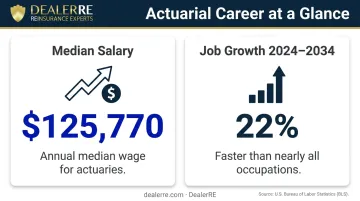
According to BLS data from May 2024, actuaries earn a median salary of $125,770, with employment projected to grow 22% from 2024 to 2034 — faster than nearly any other occupation. In reinsurance specifically, actuarial compensation frequently exceeds industry medians given the complexity of multi-line and catastrophe modeling.
Credentials matter here. The Casualty Actuarial Society (CAS) administers the ACAS and FCAS designations for property-casualty practice. The FCAS pathway requires:
- Completing Exams 1 through 9
- Validation by Educational Experience (VEE) topics
- A Course on Professionalism
That's a multi-year commitment — and one that signals serious technical depth to any reinsurance employer.
Underwriting Roles
Reinsurance underwriters evaluate risk submissions from ceding insurers and decide whether — and on what terms — to accept them. Strong judgment, product knowledge, and treaty literacy are the core requirements.
The BLS reports a median salary of $79,880 for insurance underwriters as of May 2024. Demand projections show modest decline (-3% through 2034) as automation handles more routine submissions. Underwriters who combine reinsurance-specific expertise with analytics fluency will have a clear edge as the role evolves.
Claims and Technical Roles
Claims professionals in reinsurance adjudicate complex losses, interpret treaty language, and work with primary insurers on settlement strategy. In dealer reinsurance specifically, claims adjudication on vehicle service contracts is a core daily function — determining what's covered, coordinating with repair facilities, and managing loss ratios that directly affect the dealer's profit participation.
DealerRE works alongside its administrator partner to handle claims adjudication for dealer clients, ensuring that repairs are approved efficiently and the dealer's reinsurance company's book remains well-managed.
Account Management and Business Development
Account managers are the face of the reinsurance operation to clients. In dealer reinsurance, that means building ongoing relationships with dealer principals, communicating program performance, and helping dealers understand their financial position quarter over quarter.
This is a natural entry point for people coming out of dealerships. Parker Byrd, DealerRE's Vice President, worked as both an F&I Manager and a Salesman before joining the company, and that floor experience shapes how he engages with dealer clients today. Brenda West, DealerRE's Account Manager, brings over 20 years of insurance industry experience alongside her own F&I manager background. Insurance operations knowledge paired with real dealership experience is what makes someone genuinely effective in this role.
Administrative and Compliance Roles
Every reinsurance program requires ongoing back-office support. In dealer-owned programs, each dealer's reinsurance entity carries its own compliance obligations at the state and federal level. That typically includes:
- Regulatory filings and renewals
- Tax returns and bookkeeping
- Performance reporting
- Legal compliance documentation
DealerRE manages all of this on behalf of its dealer clients so dealers can stay focused on running their stores.
What It's Really Like Working in Reinsurance
The common assumption is that reinsurance is dry, numbers-heavy work buried somewhere behind insurance — the kind of career that doesn't make for good dinner conversation. Industry professionals would disagree.
Alex Mican, writing about his first year in reinsurance, describes quickly deciding to make a career of it after discovering the combination of technical depth, strong professional community, and genuine intellectual challenge. Tom Johansmeyer, in a separate piece, highlights the field's pull across catastrophe bonds, ILS structures, and market cycles — and the satisfaction that comes from continuous learning built into the daily work.
The risks keep changing — and so does the work.
Compensation Reality
Pay varies significantly by role and seniority:
| Role | Median Pay (May 2024) | 10-Year Outlook |
|---|---|---|
| Actuary | $125,770 | +22% growth |
| Insurance Underwriter | $79,880 | -3% change |
At senior levels, base salary is only part of the picture. Swiss Re's publicly disclosed compensation data shows variable pay comprising 73–77% of total compensation for Group Executive Committee members — meaning performance bonuses and equity represent the majority of senior reinsurance earnings.
In dealer-owned reinsurance, the structure is different but often more lucrative for the dealer principal. Rather than receiving a salary, the dealer participates directly in underwriting profits — retaining 100% of what their reinsurance company earns after claims are paid.
Culture and Long-Term Trajectory
Reinsurance is relationship-driven. Professionals build multi-year partnerships with clients — whether those are insurance companies or, in the dealer space, dealership owners who rely on their reinsurance partner for strategic guidance, program performance analysis, regulatory compliance, and ongoing education.
Those relationships translate directly into career trajectory. Professionals who build deep product expertise and client trust typically advance into:
- Senior underwriting or portfolio management roles
- Executive leadership within reinsurance carriers or administrators
- Independent consulting, leveraging long-term client networks
In the dealer-owned model, the program's financial value compounds each year — reserves accumulate, the reinsured contract book expands, and the dealer principal's equity position grows alongside the business.
Dealer-Owned Reinsurance: A Unique Career and Business Opportunity
Most dealers selling F&I products — vehicle service contracts, GAP, tire and wheel, door ding protection — are sending a significant portion of their economics to third-party providers. The dealer earns a gross profit on the sale. The third party keeps the underwriting profit: the difference between premiums collected and claims paid.
Dealer-owned reinsurance flips that structure.
How the Program Works
Through an administrator-obligor structure, the dealer establishes their own reinsurance company. When F&I products are sold, premiums are ceded to the dealer's reinsurance entity and held in a custodial account at a Trust Company.
Those reserves are invested conservatively — typically in government bonds — and generate investment income that also belongs to the dealer's company.
Withdrawals from the trust are permitted for four purposes: paying covered repair claims, limited professional fees, income taxes, and excess funds once reserves exceed 125% of unearned premiums. Once that threshold is crossed, the dealer can direct excess funds more aggressively.
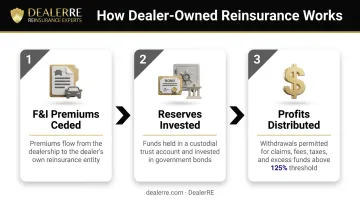
The financial result: the dealer maintains their existing gross profit on F&I sales and captures the underwriting profit that previously went to the vendor. As DealerRE describes it, this is essentially like owning a warranty company solely for your store and your customers.
What Dealers Do With Accumulated Profits
DealerRE clients have used their reinsurance earnings for:
- Real estate purchases
- College funding for their children
- Reinvestment back into the dealership
- Acquiring other assets (watercraft, additional properties)
One client described it as "one of the best decisions I ever made in the used car business." Another noted it gave them "a line of capital to fall back on" — a reserve that didn't exist before.
Products Available Through DealerRE
For franchise and retail dealers:
- Vehicle service contracts
- GAP coverage
- Tire & wheel protection
- Door ding protection
- Windshield repair
- Theft protection
- Certified pre-owned warranty programs
For BHPH dealers:
- Collateral protection insurance (CPI)
- Debt cancellation coverage (DCC)
- Vendor single interest (VSI)
- Vehicle service contracts (with monthly premium billing to protect cash flow)
- GAP
The Support Ecosystem
Setting up and running a dealer-owned reinsurance company requires qualified back-office support. DealerRE handles legal filings, tax returns, compliance management, bookkeeping, performance reporting, claims adjudication, and F&I training — every administrative function a dealer's program requires. The dealer owns the company and participates in profits; DealerRE manages the operational complexity.
The admin obligor structure also includes backing from A-rated insurers, adding a financial security layer for the dealer's program and their customers.
For F&I managers and dealership staff, understanding how these programs operate builds practical expertise spanning automotive retail, financial products, and insurance compliance. That combination is hard to find — and dealers who've built their own programs tend to keep the people who understand them.
How to Break Into the Reinsurance Industry
Traditional Reinsurance
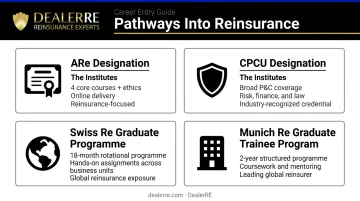
Most entry points come through adjacent fields: actuarial science, finance, risk management, or primary insurance. Two credentials stand out as widely recognized entry points:
- Associate in Reinsurance (ARe) from The Institutes — four core courses plus ethics, delivered online, focused on reinsurance programs and treaty execution
- CPCU (Chartered Property Casualty Underwriter) from The Institutes — broad P&C operations, risk, finance, and law
Large global reinsurers also run structured graduate programs. Swiss Re offers an 18-month programme with rotational assignments; Munich Re runs a two-year International Graduate Trainee Program combining coursework, mentoring, and core role preparation. Both provide formal on-ramps for analytically strong candidates entering the field.
Dealer Reinsurance
The natural entry point here is through automotive retail. Professionals with hands-on dealership experience — F&I managers, finance directors, and GMs — already understand how vehicle service contracts and GAP coverage work, how to present them, and what dealers care about. That knowledge translates directly into account management or consulting roles within dealer reinsurance.
Industry events are one of the fastest ways into this space. Taylor Byrd, President of DealerRE, speaks regularly at NIADA national and state independent dealer association events and has appeared on The Independent Dealer Podcast to discuss dealer-owned reinsurance opportunities.
Being in those rooms — asking questions, meeting practitioners, hearing what's working for other dealers — is often how professionals discover this niche and decide to pursue it seriously. A few ways to get started:
- Attend NIADA national or state independent dealer association conferences
- Follow industry podcasts such as The Independent Dealer Podcast
- Connect with administrators and consultants already active in dealer reinsurance
- Reach out directly to firms like DealerRE that operate in this space
DealerRE welcomes inquiries from professionals interested in this niche. Reach out to Careers@DealerRE.com to explore what roles and opportunities might be available.
Frequently Asked Questions
Does working in reinsurance pay well?
Yes. Reinsurance is generally well-compensated, particularly for credentialed professionals. Actuaries in the field earn a median of $125,770, while senior roles at major reinsurers include substantial variable pay tied to performance. In dealer-owned reinsurance, the dealer owner's financial return can far exceed a traditional employment model, since they capture 100% of underwriting profits rather than drawing a fixed wage.
Is working in reinsurance a good career choice?
Generally, yes — and retention rates reflect that. The field offers intellectual challenge, consistent demand across economic cycles, and expertise that compounds meaningfully over a career. Long-term client relationships in program management add a dimension of depth that more transactional roles rarely provide.
What is it like working in reinsurance day-to-day?
It varies by role. Actuarial work is data-intensive and model-driven; account management is relational, centered on client communication and performance reviews; claims work blends both. Most practitioners find the day-to-day more engaging than outsiders expect, with continuous learning built into the problems they solve.
What skills do you need to work in reinsurance?
Core skills include analytical thinking, financial literacy, and strong communication. In dealer reinsurance specifically, F&I experience and familiarity with automotive retail operations are particularly valuable. That background helps you relate to dealer clients and translate complex program mechanics into practical business terms.
What is the difference between reinsurance and insurance?
Insurance covers end customers — individuals and businesses buying protection for their cars, homes, or commercial interests. Reinsurance covers insurance companies themselves, transferring risk from the primary insurer's balance sheet to the reinsurer. In the dealer-owned model, the dealer's reinsurance entity covers the F&I products sold at their store, capturing the underwriting economics rather than passing them to a third party.
How do I get started with a dealer-owned reinsurance program?
Start with a conversation. DealerRE offers a complimentary business analysis that looks at your dealership's F&I volume, product mix, and current structure to illustrate what a reinsurance program could return. From there, they handle the full setup — company formation, legal filings, staff training, and ongoing administration. Call (804) 824-9533 or visit dealerre.com to get started.