Introduction
Few moments in the F&I office are more damaging to a dealer relationship than a customer returning after a claim denial — convinced they were sold something they weren't. When a transmission fails and the customer discovers that component wasn't explicitly named in their service contract, the resulting dispute costs more than just the repair bill. It costs trust, referrals, and future deals.
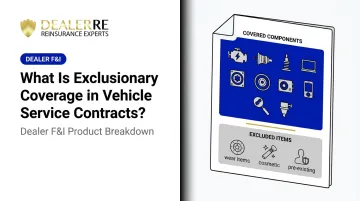
Exclusionary vehicle service contracts exist precisely to eliminate that scenario. Rather than listing every covered component, an exclusionary VSC flips the model entirely: everything is covered unless the contract specifically says otherwise.
This article covers what exclusionary coverage is, how it differs structurally from named-component plans, and what it excludes. It also explains why exclusionary VSCs represent the strongest product in your lineup and a real F&I profit opportunity — particularly for dealers who retain underwriting profits through a reinsurance structure.
TL;DR
- Exclusionary VSCs cover every mechanical and electrical component except those explicitly named on the exclusion list — unlike named-component plans that only cover what's listed
- Common exclusions include routine maintenance, wear items, cosmetic parts, pre-existing conditions, and aftermarket modifications
- The claims dynamic shifts favorably: coverage is presumed unless a part appears on the exclusion list
- Exclusionary plans sit at the top of the VSC pricing tier and carry the highest per-deal gross potential
- Dealers who reinsure exclusionary VSCs through their own program keep the underwriting profit — rather than sending it to a third-party administrator
What Is Exclusionary Coverage in a Vehicle Service Contract?
The "Cover Everything Except" Model
Exclusionary coverage is exactly what the name implies: the contract defines what is not covered, and everything else is protected by default. American Auto Shield defines it as "protection for all of the parts and components of the covered vehicle, with the exception of those parts and components specifically listed in the vehicle service contract as 'not covered.'"
Compare that to a traditional named-component plan, where a part must appear on the covered list before a claim is approved. Miss a component (even an expensive one) and the claim gets denied. Exclusionary coverage eliminates that gap by flipping the logic entirely.
Where It Sits on the VSC Spectrum
| Tier | Coverage Logic | Scope | Relative Cost |
|---|---|---|---|
| Powertrain | Named-component | Engine, transmission, drivetrain only | Lowest |
| Stated-Component | Named-component | Specific parts listed in contract | Mid-range |
| Exclusionary | Exclusion-based | All parts except those listed as excluded | Highest |
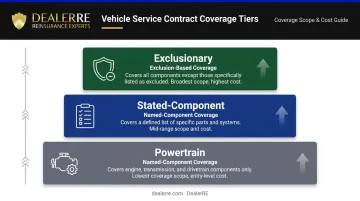
Exclusionary plans carry the highest premium because they assume the broadest risk. That higher price point reflects the widest scope of protection any VSC tier offers.
The "Bumper-to-Bumper" Problem
The industry commonly refers to exclusionary plans as "bumper-to-bumper" coverage, but this term creates compliance risk. F&I and Showroom magazine explicitly advises F&I managers to avoid using it, because it leads customers to believe everything is covered — which is never true for any VSC. The Washington State Office of Insurance Commissioner echoes this: even "bumper-to-bumper" coverage almost always includes limitations and exclusions.
"Exclusionary coverage" is the accurate term — it sets honest expectations without inviting disputes at claim time.
VSC vs. Warranty: A Critical Distinction
A VSC is not a warranty. The FTC is clear on this point: "An auto service contract or extended warranty is not a warranty as defined by federal law, because you buy it separately." Under the Magnuson-Moss Warranty Act, a written warranty must be included in the purchase transaction at no additional cost; a VSC requires separate consideration.
Using the word "warranty" when selling a VSC can trigger federal enforcement action. Make sure your F&I team understands the distinction before they hit the showroom floor.
Exclusionary vs. Named-Component Coverage: Key Differences
How the Claim Question Changes Everything
The structural difference between these two plan types comes down to a single question asked at claims time:
- Named-component plan: "Is this part on the covered list?"
- Exclusionary plan: "Is this part on the exclusion list?"
That reversal matters enormously. With a named-component plan, the burden falls on the customer to prove a component is covered. With an exclusionary plan, coverage is presumed — the administrator must identify a specific exclusion to deny the claim. Fewer denials, fewer disputes, better customer experience.
Side-by-Side Comparison
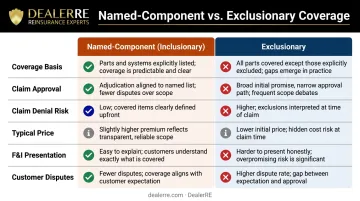
| Factor | Named-Component (Inclusionary) | Exclusionary |
|---|---|---|
| Coverage basis | Must be explicitly listed | Covered unless explicitly excluded |
| Claim approval | Requires component to match covered list | Requires component to match exclusion list |
| Claim denial risk | Higher — unlisted parts auto-excluded | Lower — only excluded parts are denied |
| Typical price | Lower | Higher |
| F&I presentation | Requires explaining what's covered | Simpler: "everything except this short list" |
| Customer disputes | More common | Less common |
Why Exclusionary Coverage Costs More
The table above makes the trade-off visible: broader protection, fewer denials, fewer disputes. That broader protection is exactly why exclusionary plans carry a higher price. Exclusionary coverage costs more because it covers more.
Customers sometimes resist that premium until they see what they're actually getting. The F&I manager's job isn't to defend the price — it's to make the value impossible to ignore. A long named-component list can look thorough in a brochure, but when a customer asks "will my repair be covered?", a short exclusion list gives a cleaner, more confident answer than any multi-page covered-components schedule can.
What Does Exclusionary Coverage Typically Exclude?
Every exclusionary contract still carries an exclusion list — and no two are identical. Dealers and F&I teams must read it carefully, because that list defines exactly where the contract's liability ends. Six exclusion categories appear consistently across the industry:
The Six Standard Exclusion Categories
| Category | Common Items | Why It's Excluded |
|---|---|---|
| Routine maintenance | Oil changes, filter replacements, tire rotations, tune-ups | Scheduled upkeep, not mechanical failure |
| Wear-and-tear parts | Brake rotors, clutch components, belts, wiper blades | Normal degradation expected over time |
| Pre-existing conditions | Failures present before contract purchase, known defects | Risk already existed at point of sale |
| Cosmetic damage | Paint, trim, upholstery, glass (unless add-on applies) | Aesthetic, not mechanical or operational |
| Abuse or neglect | Damage from overloading, misuse, missed maintenance | Customer-caused failure, not product defect |
| Environmental or collision damage | Flood, fire, accident, theft, road hazard | Covered under auto insurance, not VSC |
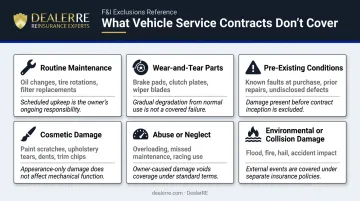
Reading the exclusion list closely matters for two reasons. First, it determines what claims your program will actually pay — and therefore how customers experience it. Second, for dealers running their own reinsurance programs, the exclusion structure directly affects loss ratios and reserve requirements. A tighter exclusion list may reduce claims exposure, but it also affects perceived value at the point of sale.
The goal is balance: an exclusion list narrow enough to be financially sound, but broad enough that customers feel genuinely protected when something goes wrong.