

Introduction
The global reinsurance industry functions as the financial foundation beneath every insurance policy written worldwide. When a hurricane wipes out a coastal city or a single catastrophe generates billions in claims, no individual insurer could absorb that exposure alone — reinsurers step in to carry what primary carriers cannot.
According to Gallagher Re's 2024 Reinsurance Market Report, global reinsurance dedicated capital reached $769 billion at full-year 2024 — a 5.4% increase year-over-year. That figure reflects the scale and confidence of a market that touches every sector of the global economy.
Understanding how that market is structured — who leads it, how rankings are determined, and what separates the top tier — helps explain why reinsurance works as a mechanism at any scale. This article profiles the top five global reinsurers and breaks down the criteria that define elite performance. Auto dealers will also find a practical parallel: the same risk-transfer logic that operates at the global level applies directly to dealer-owned reinsurance structures at the dealership level.
TL;DR
- Swiss Re leads AM Best's IFRS 17 ranking with $36.2B in gross reinsurance revenue; Munich Re ranks second at $32.6B
- AM Best ranks reinsurers on two parallel tracks — gross reinsurance revenue (IFRS 17) and gross written premium (non-IFRS 17)
- The top five reinsurers collectively span P&C, life & health, specialty, and catastrophe lines across 100+ countries
- Berkshire Hathaway holds the largest capital base at $428.6B in shareholders' funds — more than 10x the next-largest reinsurer
- Dealers can apply the same risk transfer principle at their level through dealer-owned reinsurance programs like DealerRE
Overview of Global Reinsurance
Reinsurance is insurance purchased by insurance companies. The IAIS Glossary defines it as an arrangement where a reinsurer agrees to indemnify a ceding company for part or all of the liability that ceding company has assumed under its own policies — in exchange for a share of the premium.
Without reinsurance, primary insurers would be forced to hold far more capital to cover tail risks, making coverage either impossibly expensive or simply unavailable for large-scale events. Reinsurance solves that problem by distributing catastrophic exposure across multiple, highly capitalized entities.
Market Size and Regional Breakdown
The $769 billion in global dedicated reinsurance capital is concentrated among a relatively small number of large institutions. Three structural patterns define the market:
- European dominance: Munich Re, Swiss Re, and Hannover Re are all headquartered in Europe and account for an outsized share of global capacity
- North American strength: Berkshire Hathaway operates from Omaha and brings the most capital of any single reinsurer in the world
- Specialty market breadth: Lloyd's of London underwrites risk across 200+ territories through its syndicate model
Understanding how this capital is distributed — and which institutions control it — is the starting point for evaluating the top players in global reinsurance.
Top Global Reinsurance Companies Rankings
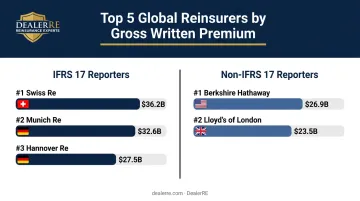
AM Best's annual "World's 50 Largest Reinsurers" report is the industry's definitive ranking source. Companies are ranked by gross reinsurance revenue if they report under IFRS 17, or by gross written premium (GWP) if they report under non-IFRS 17 standards. The 2025 edition covers full-year 2024 financial data.
The five profiled below represent the largest reinsurers by revenue across both reporting frameworks:
- Swiss Re — #1 (IFRS 17), $36.2B gross reinsurance revenue
- Munich Re — #2 (IFRS 17), $32.6B gross reinsurance revenue
- Hannover Re — #3 (IFRS 17), $27.5B gross reinsurance revenue
- Berkshire Hathaway Reinsurance Group — #1 (Non-IFRS 17), $26.9B gross written premium
- Lloyd's of London — #2 (Non-IFRS 17), $23.5B gross written premium (reinsurance only)
Munich Re
Munich Re is Germany's largest reinsurer and one of the two most recognized names in global reinsurance. It operates across life & health, property & casualty, and specialty segments, doing business with over 4,000 corporate clients in 160+ countries.
| Metric | Detail |
|---|---|
| Headquarters | Munich, Germany |
| Primary Segments | P&C, Life & Health, Specialty (cyber, aviation, engineering, renewable energy) |
| Gross Reinsurance Revenue (IFRS 17) | $32,555M |
| Combined Ratio (AM Best) | 77.3% |
| Shareholders' Funds | $34,245M |
| AM Best Rank (IFRS 17) | #2 |
Munich Re's 77.3% combined ratio is the strongest among the top five — a sign of rigorous underwriting discipline across its P&C book. Its specialty reinsurance portfolio spans cyber, aviation, renewable energy, and engineering risks. A new Global Specialty Insurance (GSI) reporting segment launches in 2025 with a targeted combined ratio of 90%.
Group net income for 2024 reached EUR 5.7 billion, and return on equity came in at 18.2% — figures that reinforce its position as one of the most profitable reinsurers in the world despite ranking second on gross revenue.
Swiss Re
Swiss Re, headquartered in Zürich, adopted IFRS 17 for its 2024 reporting cycle — a change that moved it directly to the #1 position in AM Best's IFRS 17 ranking. Its product portfolio covers P&C reinsurance, life & health reinsurance, and corporate solutions.
| Metric | Detail |
|---|---|
| Headquarters | Zürich, Switzerland |
| Primary Segments | P&C, Life & Health, Corporate Solutions |
| Gross Reinsurance Revenue (IFRS 17) | $36,181M |
| Combined Ratio (AM Best) | 89.9% |
| Shareholders' Funds | $31,037M |
| AM Best Rank (IFRS 17) | #1 |
Swiss Re's NatCat Modelling Engine (NCME) comprises 160+ proprietary catastrophe risk models covering six major perils — developed and continuously calibrated by its internal Catastrophe Perils team. This in-house capability lets Swiss Re price and manage natural catastrophe risk with greater precision than carriers relying on third-party models.
Group net income for 2024 was USD 3.2 billion with a group ROE of 15.0%. Swiss Re operates from approximately 70 offices worldwide.
Hannover Re
Hannover Re (Hannover Rück SE) is Germany's second-largest reinsurer and ranks #3 among IFRS 17 reporters in the AM Best table. Its balanced P&C and life & health book spans five continents.
| Metric | Detail |
|---|---|
| Headquarters | Hanover, Germany |
| Primary Segments | P&C, Life & Health (global, 5 continents) |
| Gross Reinsurance Revenue (IFRS 17) | $27,480M |
| Combined Ratio (AM Best) | 86.6% |
| Shareholders' Funds | $12,718M |
| AM Best Rank (IFRS 17) | #3 |
Hannover Re operates from 27 offices with approximately 3,900 employees across Africa, the Americas, Asia, Australia, and Europe. Its 2024 P&C combined ratio improved sharply from 94.0% to 86.6%, and group net income jumped 28% year-over-year to EUR 2.3 billion. Financial strength ratings stand at AA- (S&P) and A+ (AM Best).

Berkshire Hathaway Reinsurance Group
Berkshire Hathaway's reinsurance operations run through subsidiaries including General Re and National Indemnity Company. It reports under U.S. GAAP and ranks #1 among non-IFRS 17 reporters in AM Best's parallel table.
| Metric | Detail |
|---|---|
| Headquarters | Omaha, Nebraska, USA |
| Primary Segments | P&C, Catastrophe Excess-of-Loss, Treaty and Facultative |
| Gross Written Premium (Non-IFRS 17) | $26,906M |
| Combined Ratio (AM Best) | 82.9% |
| Shareholders' Funds | $428,563M |
| AM Best Rank (Non-IFRS 17) | #1 |
Berkshire's $428.6 billion in shareholders' funds dwarfs every other reinsurer on this list by a factor of ten. That capital depth allows it to absorb single-event catastrophe risks that would be unwritable elsewhere. General Re, its primary reinsurance subsidiary, holds $20 billion in capital, carries an AM Best rating of A++, and operates from 36 locations across 22 countries.
Lloyd's of London
Lloyd's is not a single company — it's a specialist insurance and reinsurance marketplace operating through 107 active syndicates, 50+ managing agents, and 403 registered broker firms across 200+ countries and territories.
| Metric | Detail |
|---|---|
| Headquarters | London, United Kingdom |
| Primary Segments | Aviation, Cyber, Marine, Political Risk, Terrorism, Specialty P&C |
| Gross Written Premium — Reinsurance Only (Non-IFRS 17) | $23,537M |
| Combined Ratio (AM Best) | 87.7% |
| Shareholders' Funds | $39,150M |
| AM Best Rank (Non-IFRS 17) | #2 |
Lloyd's total market GWP reached GBP 55.5 billion in 2024, of which reinsurance accounted for GBP 15.6 billion (28%). Underwriting profit for the year came in at GBP 5.3 billion, with profit before tax reaching GBP 9.6 billion.
Its syndicate structure lets Lloyd's underwrite highly specialized and hard-to-place risks — cyber attacks, terrorism, political risk, and aviation exposures — that traditional monoline carriers typically decline. That breadth is a product of 330+ years of syndicate-based underwriting, where each syndicate brings its own capital and expertise to risks that a single-balance-sheet carrier simply cannot absorb alone.
How We Chose the Best Global Reinsurers
The AM Best Dual-Track Methodology
AM Best's ranking methodology evolved significantly when many European and Asian reinsurers adopted IFRS 17. Under this standard, "insurance revenue" replaces "gross premiums written" as the top-line metric — and the two figures are not directly comparable.
This created two parallel ranking tracks:
- Track 1: Gross reinsurance revenue — for IFRS 17 adopters (Munich Re, Swiss Re, Hannover Re)
- Track 2: Gross written premium — for non-IFRS 17 reporters (Berkshire Hathaway, Lloyd's)
AM Best's methodology also excludes affiliated and intergroup reinsurance, isolating only third-party business for comparison purposes. All currencies are converted to USD at the exchange rate applicable to each company's financial statement date.
Core Evaluation Factors
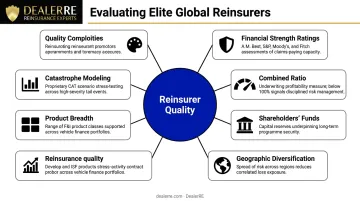
Beyond premium volume, elite global reinsurers are measured on:
- Financial strength ratings — AM Best, S&P, and Moody's ratings reflect claims-paying ability and balance sheet resilience
- Combined ratio — A ratio below 100% signals underwriting profit; Munich Re's 77.3% is exceptional
- Shareholders' funds — The capital cushion available to absorb catastrophe losses without impairing operations
- Geographic diversification — Spread across regions reduces correlated loss exposure
- Product breadth — Coverage across P&C, life & health, and specialty lines reduces earnings volatility
- Catastrophe modeling capability — Proprietary models give top reinsurers a pricing advantage on complex risks
What Changes for Auto Dealers
Carrier-level criteria — financial ratings, combined ratios, catastrophe modeling — don't translate to dealer reinsurance decisions. For auto dealers, the evaluation looks entirely different. What matters is:
- Program structure and profit retention mechanics
- Claims adjudication and compliance management
- Administrative support and monthly financial reporting
- IRS 831(b) compliance and company setup
DealerRE handles each of these areas directly, so dealers capture underwriting profits without taking on the administrative and compliance workload themselves.
Conclusion
Global reinsurance is concentrated among a small group of financially powerful institutions. Munich Re, Swiss Re, Hannover Re, Berkshire Hathaway, and Lloyd's set the standard for risk transfer at the carrier level — each distinguished by capital strength, geographic reach, and decades of underwriting discipline.
But scale doesn't automatically mean alignment. Choosing the right reinsurance partner — at any level — comes down to operational fit, financial transparency, and long-term program performance.
For auto dealers, that principle is actionable today. Instead of sending F&I underwriting profits to third-party providers, dealers can establish their own reinsurance company and keep what they've earned. DealerRE has helped more than 400 dealers do exactly that since 1994 — with full-service setup, compliance management, claims adjudication, and ongoing support included. If you're ready to stop paying profits to vendors and start retaining them, contact DealerRE to get your program started.
Frequently Asked Questions
Who is the largest reinsurance company in the world?
It depends on the metric. Under AM Best's IFRS 17 gross revenue ranking, Swiss Re leads at $36.2B versus Munich Re's $32.6B. Among non-IFRS 17 reporters, Berkshire Hathaway tops the list with $26.9B in GWP and an unmatched $428.6B capital base.
Who are the top reinsurance companies?
The consistently top-ranked global reinsurers are Munich Re, Swiss Re, Hannover Re, Berkshire Hathaway, and Lloyd's of London. AM Best ranks them annually using gross reinsurance revenue for IFRS 17 reporters and gross written premium for non-IFRS 17 reporters.
What is the top line in reinsurance?
The "top line" refers to gross written premium (GWP) for non-IFRS 17 reporters, or gross reinsurance revenue for IFRS 17 adopters — both represent total premium recognized before deducting ceded amounts and expenses. AM Best uses these figures as the primary basis for its global reinsurer rankings.
How are global reinsurance companies ranked?
AM Best publishes the definitive annual ranking using gross written premium for non-IFRS 17 companies and gross reinsurance revenue for IFRS 17 adopters. Supporting metrics — combined ratio, shareholders' funds, and financial strength ratings — assess underwriting quality and balance sheet resilience beyond top-line volume.
What is the difference between reinsurance and primary insurance?
Primary insurance is sold directly to policyholders to cover specific risks. Reinsurance is purchased by insurance companies themselves to limit their exposure to large or catastrophic losses — transferring a portion of their risk portfolio to a reinsurer in exchange for a share of premiums. Reinsurers typically have no direct relationship with the end consumer.
What is dealer-owned reinsurance and how does it differ from global reinsurance?
Dealer-owned reinsurance lets auto dealerships establish their own reinsurance companies to capture underwriting profits on F&I products — such as vehicle service contracts and GAP — instead of paying third-party providers. Specialists like DealerRE handle setup, compliance, and ongoing administration, applying the same risk transfer principles used by global carriers at the dealership level.