For institutional counterparties, the numbers tell a sobering story. R&Q reported a $58 million operating loss in the first half of 2023, driven by $40 million in adverse reserve development. Skyward Specialty Insurance later recognized $9.8 million in uncollectible reinsurance recoverable after commuting its contract with R&Q Re Bermuda.
For auto dealers and F&I professionals, the story carries a different kind of lesson: when you depend on a third-party reinsurance company to back your warranty and F&I products, you're exposed to risks you can't see — until it's too late.
This article explains who R&Q was, what drove the liquidation, how the process unfolded, and what the R&Q Re Bermuda scheme of arrangement means — and what it signals for dealers evaluating their reinsurance arrangements.
TL;DR
- R&Q Insurance Holdings entered provisional liquidation in Bermuda in June 2024 after years of reserve failures and mounting debt
- Program management unit Accredited sold to Onex Corp. for $465 million
- UK legacy unit Inceptum sold to Marco Capital for £11.3 million
- R&Q Re (Bermuda) resolved through a court-sanctioned scheme of arrangement, approved by creditors and the Bermuda Supreme Court in early 2025
- Even under that orderly resolution, counterparties like Skyward Specialty still absorbed real financial losses
- Dealers relying on third-party reinsurance companies carry similar hidden exposure — dealer-owned structures eliminate that dependency
What Was R&Q Reinsurance Company?
R&Q Insurance Holdings Ltd. was a Bermuda-domiciled specialty insurer and reinsurer listed on the London AIM exchange. Its core business was acquiring and managing legacy or "run-off" insurance portfolios, meaning books of business that had stopped writing new premiums but still carried long-tail claims obligations.
The scale of this market is significant: PwC's 2024 Global Insurance Run-off Survey estimated global non-life run-off reserves at over $1 trillion, with North America accounting for $489 billion.
R&Q operated through five principal entities:
| Entity | Domicile | Function |
|---|---|---|
| R&Q Re (Bermuda) Ltd. | Bermuda | Legacy reinsurance; Class 3A reinsurer |
| R&Q Reinsurance Company (R&Q Re US) | Pennsylvania, USA | US-domiciled legacy reinsurance |
| Accredited | USA | Property/casualty program manager |
| Inceptum Insurance Co. Ltd. | UK | Legacy general insurance acquisitions |
| Gibson Re | Bermuda | Collateralized legacy sidecar vehicle |
Understanding this structure matters because each entity faced a different fate on a different timeline — and any counterparty's exposure depended entirely on which R&Q entity they contracted with.
That counterparty distinction points to the most consequential difference in the entire structure: Accredited (program management) operated as a separate, functionally independent business from R&Q's legacy acquisition units. That separation is what made Accredited sellable as a going concern even as the parent collapsed.
What Caused R&Q to File for Liquidation?
The collapse wasn't sudden. Several problems compounded over years before the 2024 filing.
Adverse Reserve Development
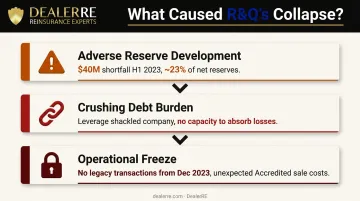
The primary driver was reserve inadequacy in the legacy acquisition business. R&Q disclosed an H1 2023 pre-tax operating loss of $58 million, with $40 million attributable to adverse reserve development on older Lloyd's transactions and a COVID-related claims backlog. Full-year 2023 adverse development was projected at approximately 23% of the group's net reserves — a systemic problem, not an isolated one.
A Debt Load That "Shackled" the Company
Reserve deterioration was serious, but the debt burden removed any path to recovery. Industry commentary described R&Q's leverage as having "shackled the company," leaving it without the financial flexibility to absorb losses or raise stabilizing capital once the reserve picture deteriorated.
Operational Breakdown
Two additional factors compounded the damage:
- Inability to close legacy transactions — R&Q disclosed it had been constrained from executing external legacy transactions since December 2023, which was its core revenue-generating activity. When deal flow stopped, so did the business model.
- Accredited sale costs — The prolonged process of selling Accredited to Onex generated "significant additional unexpected costs and expenses," adding strain rather than relief.
April 2024: The Pre-Filing Warning Signs
In April 2024, R&Q sold its 49% stake in the Obra joint venture for $30 million while simultaneously warning of a "significant pre-tax loss" for 2023. R&Q shares fell approximately 45% following those disclosures. The provisional liquidation filing came just months later — a direct consequence of the reserve failures, debt constraints, and operational freeze that had been building since late 2023.
How the R&Q Liquidation Process Unfolded
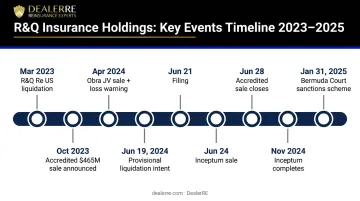
The timeline below captures how a multi-jurisdictional wind-down actually plays out — and why different stakeholders experienced it differently.
Key Timeline
| Date | Event |
|---|---|
| March 23, 2023 | R&Q Re US (Pennsylvania) placed into liquidation by PA Insurance Department |
| October 20, 2023 | R&Q announces $465M Accredited sale to Onex Partners |
| April 12, 2024 | R&Q sells Obra JV stake for $30M; warns of "significant pre-tax loss" |
| June 19, 2024 | R&Q announces intention to file for provisional liquidation |
| June 21, 2024 | Provisional liquidation filed with Bermuda Supreme Court |
| June 24, 2024 | Inceptum sale to Marco Capital announced for £11.3 million |
| June 27, 2024 | Joint Provisional Liquidators appointed; directors resign |
| June 28, 2024 | Accredited sale to Onex completed |
| November 29, 2024 | Marco Capital completes Inceptum acquisition |
| January 31, 2025 | Bermuda Supreme Court sanctions R&Q Re scheme of arrangement |
The Accredited Sale
Accredited was sold to funds advised by Onex Partners for $465 million in aggregate cash consideration, closing June 28, 2024 — one day after provisional liquidators were appointed. The provisional liquidation filing was structured specifically to enable this transaction to close promptly, preserving the maximum recoverable value from R&Q's most significant operating asset.
The Inceptum Sale
R&Q's UK legacy unit, Inceptum Insurance Co. Ltd., was sold to Marco Capital Holdings Ltd. for £11.3 million in cash. The full transaction — including related reinsurance novation arrangements — was expected to generate approximately £13 million in total liquidity. Marco Capital completed the acquisition on November 29, 2024.
R&Q Re US — A Separate, Earlier Process
R&Q Re US (Pennsylvania) entered liquidation on March 23, 2023, over a year before the Bermuda parent's filing. The Pennsylvania Insurance Commissioner was appointed as statutory liquidator. This was a completely distinct regulatory process, which many counterparties found difficult to track when mapping their actual exposure across jurisdictions.
Gibson Re
R&Q's collateralized legacy sidecar vehicle, Gibson Re, saw its future become uncertain following the provisional liquidation announcement. Investors in sidecar structures bear direct exposure to sponsor distress. When a reinsurer collapses, sidecar investors face uncertain return timelines and potential collateral losses — not just the direct policyholders.
What Is the R&Q Re Bermuda Scheme of Arrangement?
A scheme of arrangement is a court-sanctioned process that lets a company reach a binding agreement with its creditors to resolve outstanding obligations — without triggering formal insolvency. It requires majority approval by number and over 75% by value of each creditor class, plus court sanction.
For R&Q Re (Bermuda) Ltd., the scheme offered a direct alternative to a standard wind-up — one that would have cost more, taken longer, and likely produced worse recoveries for creditors.
Unanimous Approval — A First for Bermuda
On January 27, 2025, R&Q Re (Bermuda) creditors voted unanimously in favor — representing 100% of voting creditors and 99.9% of the value of claims. The Bermuda Supreme Court sanctioned the scheme on January 31, 2025.
PwC described it as "the first of its kind in Bermuda" — a structure providing for a solvent resolution binding on all creditors, without a formal insolvency filing.
Key parties involved:
- Dan Schwarzmann (PwC) — appointed Scheme Supervisor
- Conyers — Bermuda legal counsel to R&Q Re
- Bermuda Monetary Authority (BMA) — provided regulatory support cited as instrumental to the scheme's viability
What It Meant in Practice — The Skyward Example
The Skyward outcome shows what "mitigated" actually means in dollar terms. Skyward Specialty Insurance commuted its Loss Portfolio Transfer with R&Q Re (Bermuda) related to accident years 2018 and prior, receiving $11.7 million in cash. Skyward also:
- Strengthened LPT loss reserves by $25.3 million
- Recognized approximately $9.8 million (net of tax) in uncollectible reinsurance recoverable
The scheme reduced counterparty losses — but even a best-case resolution leaves creditors absorbing real shortfalls.
What This Means for Auto Dealers and Their Reinsurance Programs
The R&Q situation isn't just an institutional story. It carries direct implications for any dealer whose F&I products or warranties are backed by a third-party reinsurance company.
The Hidden Exposure in Third-Party Arrangements
When a reinsurance company enters liquidation or restructuring, businesses that relied on it face real consequences:
- Delayed claims payments as the resolution process unfolds (often over years)
- Partially uncollectible reinsurance recoverables — as Skyward Specialty experienced
- Prolonged legal uncertainty with no clear timeline for resolution
Dealers typically have zero visibility into a third-party reinsurer's reserve adequacy, debt load, or solvency trajectory. They find out about problems after a filing — not before.
Why Dealer-Owned Structures Change the Equation
DealerRE helps dealers set up and manage their own administrator obligor reinsurance companies — a structure that addresses the exact vulnerability the R&Q situation exposed.
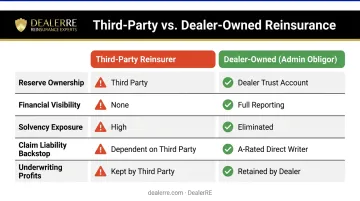
The structural difference is significant:
| Factor | Third-Party Reinsurer | Dealer-Owned (Admin Obligor) |
|---|---|---|
| Who owns the reserves | Third-party company | Dealer's own trust account |
| Visibility into financial health | None | Full reporting and analysis |
| Exposure to third-party solvency | High | Eliminated |
| Ultimate claim liability | Dependent on third party | Backed by A-rated direct writer |
| Underwriting profits | Kept by third party | Retained by dealer |
In DealerRE's admin obligor model:
- The dealer owns 100% of their reinsurance entity
- All funds are held in a U.S.-based trust account — no offshore exposure
- The dealer's company reinsures only their own dealership's business, so no outside losses affect their reserves
- If the dealer's reinsurance company cannot meet obligations, ultimate liability rests with the direct writing A-rated insurance carrier
That backstop is what makes the structure insulated from the cascading reserve and debt problems that sank R&Q. The dealer isn't dependent on anyone else's financial health to pay their customers' claims.
Frequently Asked Questions
What is the R&Q Re Bermuda scheme of arrangement?
It's a court-sanctioned creditor resolution mechanism approved unanimously by creditors and sanctioned by the Bermuda Supreme Court on January 31, 2025. Described as the first of its kind in Bermuda, it created a solvent resolution binding on all creditors without requiring a formal insolvency filing. PwC's Dan Schwarzmann served as scheme supervisor.
What caused R&Q Insurance Holdings to go into liquidation?
The primary causes were adverse reserve development in its legacy acquisition business (a $40 million shortfall in H1 2023 alone), a debt burden that constrained the company's ability to absorb losses, inability to close new legacy transactions from late 2023 onward, and unexpected costs from the prolonged Accredited sale process.
What is the difference between provisional liquidation and a scheme of arrangement?
Provisional liquidation is a court-supervised asset preservation process initiated while a company determines its path forward (it doesn't necessarily mean final dissolution). A scheme of arrangement is a separate binding creditor agreement that can resolve obligations without triggering full insolvency.
What happened to R&Q's subsidiary Accredited after the liquidation filing?
Accredited, R&Q's program management business, was sold to funds advised by Onex Partners for $465 million. The provisional liquidation filing was structured specifically to enable this sale to close quickly — which it did on June 28, 2024, one day after provisional liquidators were appointed.
Is R&Q Re US the same as R&Q Insurance Holdings?
No. R&Q Re US was a separate Pennsylvania-domiciled reinsurance subsidiary. It entered its own liquidation process under Pennsylvania Insurance Department supervision on March 23, 2023, before the Bermuda parent's June 2024 filing, and under an entirely separate regulatory framework.
How does a reinsurance company's insolvency affect dealers with F&I reinsurance programs?
When a reinsurance company fails, dealers relying on it may face delayed claims payments, uncollectible recoverables, and proceedings with no clear resolution timeline. Dealer-owned reinsurance structures backed by A-rated carriers remove that third-party dependency.