Introduction
Used car buyers are more skeptical than ever. Rising vehicle prices have raised the stakes on every purchase decision, and consumers increasingly expect documented inspections, clear disclosures, and some form of warranty protection before they'll commit. That shift is pushing franchise and independent dealers alike to move beyond the "as-is" model and formalize their Certified Pre-Owned (CPO) programs — because dealers who can credibly back their inventory command higher prices and stronger loyalty.
CPO programs allow dealers to charge a premium, improve customer retention, and generate additional F&I revenue through warranty product sales. But the label only carries weight when it's backed by a real process. Slapping "CPO" on inventory without a defined inspection checklist, documented reconditioning standards, or enforceable warranty backing won't just underperform — it can erode buyer trust and create compliance exposure.
This guide walks through the practical steps of building a CPO warranty program that holds up — operationally, financially, and from a compliance standpoint.
Whether you're a franchise dealer supplementing an OEM program or an independent building your inspection-and-warranty framework from scratch, the steps here will help you launch a program that justifies its price premium and delivers real returns.
Key Takeaways
- A CPO warranty program certifies select used inventory and backs it with a warranty, creating a premium vehicle category that commands higher margins
- Launching requires eligibility rules, a warranty backing structure, pricing strategy, compliance documentation, and staff training
- Independent dealers can build CPO-style programs without manufacturer mandates using third-party or dealer-owned warranty products
- The biggest profitability lever is the warranty product itself — dealers using dealer-owned reinsurance retain underwriting profits that third-party providers otherwise keep
- Long-term success hinges on selective certification, disciplined execution, and regular review of claims data and customer feedback
What Is a CPO Warranty Program for Dealers?
A dealer-run CPO warranty program is a formalized process by which a dealership inspects, reconditions, and certifies select used vehicles, then backs that certification with a limited warranty. Across all program types, the buyer receives an inspected vehicle, defined coverage, and documented peace of mind.
The key variable is who administers and funds the warranty — because that determines where the profit flows and how much control the dealer retains.
There are two main formats:
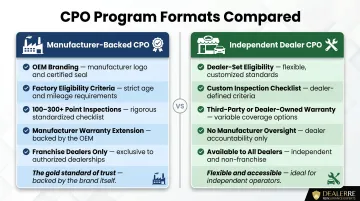
Manufacturer-backed CPO programs are available to franchise dealers who meet brand-specific standards. These programs carry OEM branding, follow factory eligibility and inspection criteria, and offer manufacturer-backed warranty extensions. Typical eligibility benchmarks include vehicles up to 5–6 model years and 60,000–85,000 miles, with multi-point inspections ranging from 100 to over 300 points depending on the brand. GM Certified uses a 172-point vehicle inspection checklist, for example.
Independent dealer-designed programs are structured, marketed, and backed by the dealer using either third-party warranty products or dealer-owned reinsurance structures. These programs allow dealers to set their own eligibility criteria, customize inspection checklists, and control warranty terms without manufacturer oversight. Independent dealers are not locked out of the CPO opportunity — they need to design the program themselves and back it with a warranty product that can pay claims.
In 2024, CPO sales totaled 2.5 million units, down slightly from 2023 but still representing a significant portion of the used vehicle market. The demand is consistent — the programs that capture it are the ones built with clear structure and backed by a warranty product buyers can rely on.
What Dealers Should Know Before Launching
Running a CPO program is not just a marketing label. It requires real operational investment: a defined inspection process, documented reconditioning standards, trained staff, and a warranty product that can actually pay claims. Dealers who skip these steps end up with certification that is unenforceable, warranty claims they can't manage, and customers who don't trust the label.
Resource Demands
Dealers must account for:
- Inspection labor — allocating technician time to complete multi-point inspections
- Reconditioning spend — average cost to bring vehicles up to certification standards (typically $300–$500 per vehicle for independent dealer programs or upwards of $2,000 per vehicle for OEM franchise programs)
- Warranty fee or reserve contribution — the cost to back the warranty, whether through a third-party product or dealer-owned reinsurance structure
- Administrative overhead — staff time for documentation, compliance, and program management
- Training costs — ensuring sales, F&I, and service teams understand the program and can execute consistently
Timeline and Volume Expectations
CPO programs take time to build customer awareness and trust. What the data consistently shows, though, is that CPO vehicles turn faster than non-certified inventory across every segment:
- CPO units sell an average of 5 days faster, yielding roughly 20% more turns per year
- J.D. Power analysis puts the advantage at about two weeks in recent market conditions
- NIADA reports 13 days faster for independent dealer programs
Improved inventory velocity shows up in your numbers within the first full cycle. Building sustained customer loyalty and reputation, however, takes longer — typically measured in quarters, not weeks.
Why Launch a CPO Warranty Program?
Buyer Demand and Price Premium
Consumers actively prefer inspected, certified vehicles when the value is clearly communicated. Autotrader's 2016 CPO Study found 3.0 million of 22.7 million in-market shoppers were interested in CPO at the time, with potential to rise to 5.2 million with better education and sales process support.
CPO vehicles command a higher asking price. Edmunds confirms CPO vehicles often carry a premium over non-certified models, reflecting the added warranty and inspection value. NIADA reports consumers pay about $750 more for a certified vehicle in independent-dealer CPO programs, paired with $300–$500 certification cost — leaving room for gross profit improvement.
Inventory Differentiation and Faster Turn
In a crowded used car market, a CPO program gives dealers a justification for higher asking prices, shorter days-to-sale, and a reason for shoppers to choose them over competitors. The data supports this:
- CPO units sell an average of 5 days faster, yielding approximately 20% more turns per year
- J.D. Power notes CPO vehicles turn about two weeks quicker than similar non-certified units
- NIADA cites CPO vehicles turning 13 days faster in independent programs
F&I Revenue Opportunity
CPO vehicles are a natural lead-in to selling vehicle service contracts, GAP coverage, and other ancillary products. Buyers who have already paid a premium for inspection and warranty are more receptive to F&I product presentations. That receptivity translates directly into higher F&I attachment rates across the board.
Customer Retention and Loyalty
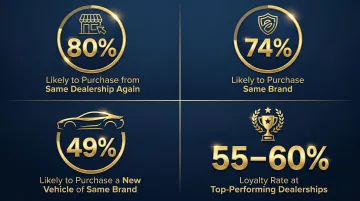
Buyers who have a positive CPO experience — especially when warranty claims are handled well — are far more likely to return. Research from Auto Remarketing shows:
- 80% of CPO owners are likely to purchase from the same dealership again
- 74% are likely to purchase the same brand
- 49% are likely to purchase a new vehicle of the same brand
- One dealership reported 55–60% loyalty from CPO customers — higher than its new-car loyalty rate
Profitability Upside for Dealer-Owned Warranty Programs
Dealers who go beyond third-party warranty products and structure their own warranty backing through a dealer-owned reinsurance program can retain the underwriting profit from every vehicle service contract sold. Instead of paying premiums to outside providers, dealers capture 100% of the reserve income and claims profit over time.
DealerRE's DealerRenew Certified program is built around this model. Dealers operate as the administrator-obligor, control claims adjudication, and direct repair work back to their own service facilities. Revenue and customer relationships stay in-house — not with a third-party provider.
How to Launch a CPO Warranty Program at Your Dealership
A CPO program is only as strong as its underlying systems. Dealers who skip key setup steps end up with certification that is unenforceable, warranty claims they can't manage, and customers who don't trust the label. Follow these steps to build a program that delivers operational consistency, customer confidence, and measurable profitability.
Step 1: Define Your Eligibility and Inspection Standards
Set clear criteria for which vehicles qualify. Common benchmarks include:
- Maximum age: Typically 5–7 model years
- Mileage caps: Often under 80,000–100,000 miles
- Condition minimums: Clean title, no structural damage, passing safety inspection
Certifying every used unit undermines the program's value. The CPO label must signal to buyers that this vehicle met higher standards than your standard used inventory.
Build or adopt a formal multi-point inspection checklist. Typical checklists range from 100 to over 300 points depending on the program. GM Certified uses a 172-point inspection, while Audi's checklist exceeds 300 points.
Document what reconditioning work must be completed before a vehicle can be certified. This documentation is what justifies the price premium to buyers and protects the dealer legally if a warranty claim arises.
Step 2: Choose How You Will Back the Warranty
You have three main options:
1. Third-party F&I product provider's vehicle service contract — simplest to set up, but profits go to the provider. You pay a premium, the provider handles claims, and you earn a commission.
2. Insurance-backed limited warranty administrator — similar to option 1 but structured as a limited warranty rather than a service contract. Compliance and legal treatment differ under federal law.
3. Dealer-owned reinsurance structure — the dealer establishes a reinsurance company, acts as the administrator-obligor, and retains 100% of underwriting profit. This requires more setup but allows the dealer to capture the full reserve income and claims profit over time.
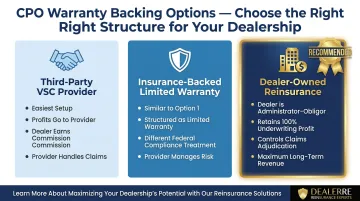
DealerRE specializes in helping dealers implement option 3. Under a dealer-owned reinsurance structure, the dealer's reinsurance company is listed as the administrator-obligor on the warranty contract. This means the dealer retains full control over the warranty program, including claims adjudication and underwriting profits.
Third-party arrangements leave the provider in control of claims and the customer experience — and the profits flow outside the dealership.
DealerRE's DealerRenew Certified program includes a 100+ point inspection and customizable warranty terms, all reinsured through the dealer's own captive reinsurance company. Dealers across the country have realized hundreds of thousands of dollars in underwriting profit through this structure.
Step 3: Set Pricing and Profitability Targets
Calculate the cost components of certifying a vehicle:
- Inspection labor
- Average reconditioning spend per unit (typically $300–$500 for independent dealer programs)
- Warranty fee or reserve contribution
- Administrative overhead
The CPO price premium must cover these costs while still leaving room for gross profit. Underpricing to win business early creates a margin problem that is hard to correct later.
Benchmark profitability: J.D. Power analysis indicates CPO gross profits are consistently stronger than similar non-CPO vehicles. NIADA reports dealers can realize about $750 higher front-end gross on a CPO versus similar non-CPO inventory. For context, public retailers averaged $1,528 gross profit per used vehicle retailed in Q3 2025.
Calculate a target per-unit profit structure and monitor it monthly.
Step 4: Handle Legal, Compliance, and Documentation
Federal framework: A written warranty included in the product price must meet Magnuson-Moss requirements. A service contract sold for a separate price is distinct under federal law. Dealers must comply with the FTC Used Car Rule, including displaying the Buyers Guide and related disclosures.
State-level compliance: Requirements vary by state. Examples include:
- California: Vehicle Service Contract Provider license requirements
- Washington: Rate and form filing requirements
- Arkansas: Provider registration and bonding requirements
- New York: Registration as service contract providers when acting as obligor
Dealers should confirm whether they are acting as a service contract provider/obligor versus selling third-party contracts as an agent, which triggers different obligations.
Documentation: Have the warranty terms, inspection checklist, and reconditioning records in writing and accessible at point of sale. This protects the dealer legally and builds buyer confidence.
DealerRE manages all legal forms, filings, tax returns, and renewals for dealers using a reinsured CPO structure, ensuring full compliance with IRS Code 831(b) and state regulations.
Step 5: Train Your Sales, F&I, and Service Teams
If the salesperson cannot explain the inspection checklist, the buyer will not pay for it. Sales staff must be able to clearly explain what the CPO certification means, why a vehicle qualified, and what specific inspection steps were completed.
F&I managers need to present warranty upsells without conflicting with the base CPO coverage. They must understand what the CPO warranty covers and where additional products like extended service contracts, GAP, or tire and wheel protection add value.
Service advisors need to know how warranty claims are processed and what is covered. Under a dealer-owned reinsurance structure, claims are handled by the dealer's administrator (such as Assured Vehicle Protection, which DealerRE partners with) and directed back to the dealer's service facility.
Inconsistent staff knowledge is one of the most common reasons CPO programs fail to hold their price premium. Training must be thorough, ongoing, and reinforced with role-playing and real-deal coaching.
Step 6: Merchandise and Market Your CPO Inventory
Digital merchandising:
- Flag CPO vehicles in all online listings (Autotrader, Cars.com, dealer website)
- Include photos of the inspection report signed by the technician
- Lead with CPO language in the vehicle description
- Check the certified box on third-party listing platforms — if you don't, CPO buyers will never see the vehicle
On-lot merchandising:
- Park CPO units in high-visibility positions
- Use window stickers that detail program benefits (inspection checklist, warranty coverage, reconditioning work performed)
- Display point-of-sale materials in the showroom and service drive
- Physically separate CPO inventory from standard used vehicles to reinforce the premium positioning
Best-practice dealers emphasize dealership-wide buy-in, certifying every eligible unit, strong merchandising on-lot and online, and staff training to present CPO value consistently.
Step 7: Monitor Claims, Performance, and Customer Satisfaction
Establish what metrics to track from day one:
- Cost per certified unit
- Warranty claim frequency and severity
- CPO vehicle gross versus non-CPO used
- F&I product attachment rate on CPO deals
- Customer satisfaction scores post-purchase
Claims data over time is the single most important feedback loop. If claim costs exceed expectations, the program pricing or eligibility criteria need adjustment before the problem compounds. Stabilize the program before expanding certified volume.
DealerRE provides performance reports and financial analysis for dealers running a reinsured CPO structure — tracking claim trends, per-unit profitability, and reserve health so dealers know exactly when to adjust pricing or tighten eligibility before losses accumulate.
Common Mistakes That Undermine CPO Programs
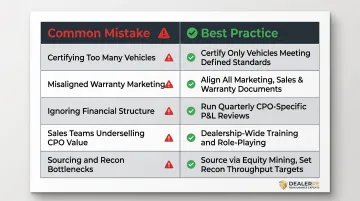
Certifying Too Many Vehicles
A CPO label applied to all used inventory signals to buyers that the certification means nothing. Selectivity is what makes the price premium defensible. Certify the best units that meet your standards, and let the rest sell as standard used inventory.
Failing to Align the Warranty Product with the Marketing
If the advertised CPO benefits — coverage terms, repair process, deductible structure — do not match the actual warranty document, the dealer faces legal exposure and customer complaints that destroy the program's reputation. Your marketing, sales presentation, and legal warranty terms must all say the same thing.
Ignoring the Financial Structure
Many dealers launch CPO programs without calculating per-unit profitability, rely on a third-party warranty with thin margins, and never revisit whether the program generates net profit. Run a quarterly P&L review specific to your CPO program and track:
- Certification costs per unit
- Reconditioning spend
- Warranty claims paid
- Gross profit per CPO unit sold
Sales Teams "Selling Around" the CPO Value
According to Auto Remarketing, sales teams frequently treat CPO as an afterthought or assume buyers already understand the benefits. Inconsistent merchandising and cosmetic neglect also undermine CPO positioning. Success requires dealership-wide buy-in and continuous training.
Sourcing and Reconditioning Bottlenecks
Over-reliance on auctions, slow reconditioning cycles, and weak post-sale communication all drag down CPO program performance. To counter these:
- Source inventory through equity mining and the service lane, not just auctions
- Monitor reconditioning cycle times continuously and set throughput targets
- Prioritize recon speed when carrying costs make delays expensive
- Follow up with CPO buyers post-sale to reinforce program value
Frequently Asked Questions
Do dealerships sell certified pre-owned vehicles?
Yes, both franchise and independent dealerships offer CPO vehicles. Franchise dealers use manufacturer-backed programs with OEM branding and standards, while independent dealers can design their own inspection-and-warranty programs using third-party or dealer-owned warranty products.
Can you get a warranty on a certified pre-owned car?
Yes, a warranty is the defining feature of a CPO vehicle. All CPO programs include at minimum a powertrain warranty, and many include broader limited warranty coverage. The scope and duration vary by program, whether manufacturer-backed or dealer-designed.
Does a certified pre-owned warranty carry over to a new owner?
It depends on the program. Manufacturer CPO warranties generally transfer with the vehicle at no charge — the Toyota Certified Used Vehicle warranty is one well-known example. Dealer-issued warranties may carry transfer restrictions, which must be disclosed at point of sale under FTC Magnuson-Moss requirements.
Is a certified pre-owned warranty worth it?
From the dealer's perspective, yes. CPO vehicles consistently sell faster and at higher gross than equivalent non-certified used inventory. CPO units sell 5–14 days faster, CPO gross profits are consistently stronger, and 80% of CPO owners are likely to buy from the same dealership again. The warranty is the key justification for that price premium.
How much does a 100,000 mile warranty cost?
Pricing depends on vehicle age, mileage, coverage tier, deductible, and surcharge categories (turbo, EV battery, luxury brand). Whether you're using a third-party provider or a dealer-owned reinsurance structure also affects your cost significantly. There's no single figure — dealers should build coverage tiers around a target budget and adjust terms accordingly.
Want to keep the underwriting profits your CPO warranty program generates? Call DealerRE at (804) 824-9533 to learn how a dealer-owned reinsurance structure lets you retain 100% of those profits — instead of handing them to a third-party provider.