

This article breaks down what a dealer-owned GAP reinsurance program actually costs to set up and run, what factors drive those costs, and how to evaluate whether the investment makes financial sense for your dealership. Understanding the full cost picture is essential before choosing a structure, because underestimating volume or ignoring program management costs can lead to misjudged ROI.
Key Takeaways
- Setup and ongoing costs exist, but retained underwriting income from a dealer-owned GAP program far outweighs them.
- Program costs vary by dealership size, GAP sales volume, structure, and administrative support level.
- Every premium collected through a third-party GAP provider sends a cut of that income out the door — a dealer-owned program keeps it.
- Independent and BHPH dealerships can qualify, not just large franchise operations, as long as GAP sales volume is consistent.
What Is a Dealer-Owned GAP Reinsurance Program?
A dealer-owned GAP reinsurance program allows a dealership to establish its own reinsurance company that "backs" the GAP products it sells. Instead of passing premiums to a third-party insurer, the dealer retains and invests those premiums, collecting underwriting profits when claims are lower than reserves.
The most common structure is admin-obligor: the dealer's reinsurance company is backed by an A-rated insurer, so customers remain fully protected, but the dealer captures the financial upside. In an Administrator-Obligor program, an administrative company serves as the obligor on the F&I contract, and a dealer-owned warranty company (DOWC) operates within this framework to retain underwriting profit.
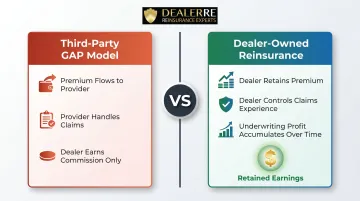
The difference from selling a standard third-party GAP product comes down to who keeps the money:
- Third-party model: Premium flows to the provider; they handle claims and pay you a commission or markup
- Dealer-owned model: You retain the premium, control the claims experience, and accumulate the underwriting profit
- Long-term advantage: Reserves that exceed claims stay in your reinsurance company and compound over time
The concept has existed for more than thirty years, evolving after tax reforms in the mid-1980s enabled small insurance company structures. DealerRE has worked with dealers inside this model since 1994 — and the dealers who haven't made the shift are still sending underwriting profit to someone else every month.
How Much Does a GAP Reinsurance Program Cost for Auto Dealers?
There is no single fixed price for a dealer-owned GAP reinsurance program—costs depend on program structure, dealership volume, administrative requirements, and what services are included. Dealers who don't understand the cost structure often avoid or underinvest in a program that consistently generates strong returns.
Setup and Formation Costs
Establishing a dealer-owned reinsurance entity involves legal formation, regulatory compliance, and initial reserve or capitalization requirements. Vendor estimates place controlled foreign corporation (CFC) setup costs around $4,000 to $5,000, with ongoing oversight companies handling annual tax filings.
These figures vary by jurisdiction and entity type. Formation of a reinsurance company is typically much less expensive than forming a full captive insurer, which requires large non-deductible capital contributions.
DealerRE emphasizes fast and easy company setup, handling all legal forms, filings, tax returns, and renewals, which streamlines the process and reduces administrative burdens for dealers. Specific setup costs and reserve minimums depend on program structure and should be discussed directly with a reinsurance program specialist.
Ongoing Program Administration Fees
Dealers typically pay a recurring fee—structured as a monthly flat fee or per-policy fee—to a program administrator who handles claims adjudication, compliance filings, tax returns, financial reporting, and staff training. The exact cost structure is negotiated and varies by provider.
Full-service administration typically covers:
- Claims adjudication and processing
- Tax return preparation and compliance filings
- Monthly financial statements and annual reports
- Staff training and ongoing support
- Performance analysis and optimization
Dealers retain responsibility for pricing decisions, customer interaction, and day-to-day operations. The administration fee covers the professional management layer that keeps the program compliant and running without pulling dealers away from the finance office.
Reserve and Premium Flow Considerations
A portion of each GAP premium collected is set aside in reserves to cover future claims. This is not a "cost" in the traditional sense—it is the dealer's own capital accumulating. Dealers pay premiums into a custodial trust account, with assets maintained equal to reserve liabilities for unearned premiums and claims, plus a small margin for fluctuations.
Understanding cash flow timing and minimum reserve thresholds is critical. Reserves are invested under NAIC-aligned guidelines, including:
- Government and corporate bonds
- Money market funds
- Issuer concentration limits
Once reserves exceed 125% of unearned premiums, excess funds may be invested more aggressively to generate additional returns.
Volume Thresholds
Industry benchmarks suggest ~20–25 vehicle service contracts per month for sustainable reinsurance programs, though GAP volume thresholds must be assessed case by case. Dealers with lower volume may face a longer break-even period; higher-volume dealers recoup costs faster and begin accumulating profit sooner.
DealerRE works with dealerships of all sizes, including independent and BHPH dealers, to assess whether current GAP sales are sufficient to make the program economically viable.
Key Factors That Affect the Cost of a Dealer GAP Reinsurance Program
Several operational and structural variables directly influence how much a dealer will invest in a GAP reinsurance program—and how quickly that investment pays off.
Program Structure and Entity Type
The choice of reinsurance structure affects complexity, cost, and tax treatment. Common structures include:
- Controlled Foreign Corporation (CFC): Often domiciled in jurisdictions like Turks & Caicos with favorable capitalization rules; can elect to be treated as a U.S. corporation for tax purposes under IRS Section 953(d)
- Small Insurance Company under IRS 831(b): Companies with less than $2.2 million in annual net premiums (indexed for inflation) can elect to be taxed only on investment income, not underwriting income
- Administrator-Obligor (Admin-Obligor): The dealer's reinsurance company is backed by A-rated carriers, which affects capitalization requirements and regulatory burden
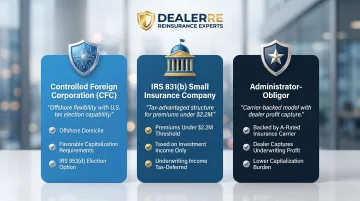
Admin-obligor structures, which DealerRE specializes in, ensure customer protection while allowing the dealer to capture underwriting profits. The administrative company or dealer-owned entity serves as the obligor, which means compliance, reporting, and capital management are non-negotiable operational priorities.
GAP Sales Volume and F&I Performance
A dealership's monthly GAP attachment rate and average GAP premium per deal directly determine how much premium flows into the reinsurance entity. Higher volume accelerates break-even and profit accumulation.
Industry context:
- GAP penetration averages around 45% across 6,000+ dealerships tracked
- F&I PVR for public dealer groups reached $2,568 in Q4 2025, reflecting strong ancillary product performance
- New-vehicle average transaction price hit $49,275 in March 2026, driving higher loan balances and increased GAP relevance
Negative equity conditions intensified in Q4 2025, with 29.3% of trade-ins toward new-vehicle purchases carrying negative equity averaging $7,214. When nearly one in three trade-ins is underwater by over $7,000, GAP coverage becomes less of an optional add-on and more of a financial necessity—which directly strengthens the premium flow into a dealer's reinsurance entity.

Claims Experience and Loss Ratio
Loss ratio is the clearest indicator of program profitability. The less frequently customers trigger GAP payouts relative to premiums collected, the more underwriting profit the dealer retains.
Target loss ratios in participation programs often hover around 70%; a 98% loss ratio is a red flag requiring operational review. GAP losses are driven by total losses and can be affected by single-event catastrophic losses (hurricanes, floods), which materially impacted dealer reinsurance positions in 2017. Recovery from major loss events is typically spread over 3–5 years to remain price-competitive.
Owning the program gives dealers direct control over the variables that shape loss exposure:
- Pricing aggressiveness relative to your customer base's risk profile
- Coverage terms offered (150% or 125% loan-to-value, deductible coverage up to $1,000)
- How claims are handled and communicated to customers
Level of Administrative Support
Self-administering a GAP reinsurance program requires in-house legal, compliance, and accounting capacity. Most dealers find that full-service administration is more cost-efficient despite the service fee, because the alternative is hiring specialized staff or consultants to manage:
- IRS compliance and tax filings (Form 1120-PC, 831(b) elections, 953(d) elections)
- State insurance regulatory filings and license renewals
- NAIC reserve investment guidelines and custodial account management
- Claims adjudication and customer service
- Monthly financial reporting and annual audits
DealerRE's full-service model covers all of these functions under one roof. For most dealers, that means the administrative fee is offset well before accounting for the underwriting profits the program itself generates.
Third-Party GAP vs. Dealer-Owned Reinsurance: What Dealers Are Really Paying
The most revealing cost comparison is not what it costs to set up a reinsurance program—it is what dealers are already paying in the form of surrendered profits every time they sell a third-party GAP product.
Surrendered Underwriting Profit
When a dealer sells a GAP product from a third-party provider, the premium is collected but the majority of underwriting income (what's left after claims) stays with the provider. In traditional third-party models, the dealer receives a commission while the administrator/insurer retains underwriting profit and investment income.
In dealer-owned reinsurance, the dealer captures commissions plus underwriting profit plus investment income. That difference—captured year after year—is where the real program ROI accumulates.
What Dealer-Owned Programs Recapture
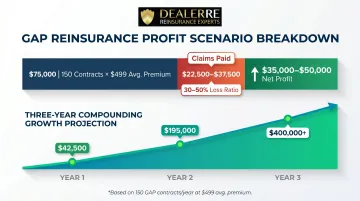
A representative scenario illustrates the opportunity: 25 vehicle service contracts per month at $1,200 average premium produced roughly $120,000 in annual underwriting profit and approximately $15,000 in investment income at 5% average, accumulating near $400,000 over three years. GAP works the same way: premiums flow into your reinsurance entity, claims are paid from your reserves, and the remaining underwriting profit belongs to you—not a third-party provider.
DealerRE clients selling 150 GAP contracts annually at $499 each would add $75,000 to receivables. GAP products typically carry favorable loss ratios—often in the 30–50% range—meaning $35,000–$50,000 of that $75,000 could become underwriting profit instead of leaving the dealership entirely.
Tax and Investment Advantages
Beyond underwriting profit, the reserves building inside your reinsurance entity can be invested for additional return. Under IRS Section 831(b), small insurance companies with premiums under $2.2 million annually are taxed only on investment income, not underwriting income. This allows tax deferral on underwriting profit until distribution.
Reserve investments follow NAIC standards: government and corporate bonds, money market funds, with concentration limits (no more than 10% in one issuer). These guardrails protect your reserves while still generating returns—and excess reserves above claim requirements can be positioned for more aggressive growth.
These tax and investment advantages are structural—they exist because of how the reinsurance entity is legally formed and operated. Consult a qualified tax advisor to understand how these benefits apply to your specific situation.
Long-Term Cost-Benefit Framing
The real metric is foregone underwriting profit—what leaves your dealership every year in the form of surrendered income. If you're selling 150 GAP contracts annually and retaining only a 20% commission on third-party GAP, you're leaving tens of thousands of dollars on the table every year. Over ten years, at even modest GAP volume, that gap in retained profit can exceed $500,000—income that could have stayed inside your own reinsurance entity.
What Most Dealers Miss When Evaluating GAP Reinsurance Costs
Dealers often make predictable mistakes when assessing reinsurance program economics:
Setup costs are one-time. Underwriting profit is not. That profit accumulates year after year — and dealers who exit early or never enter often miss how much they leave behind. Reinsurance is now viewed as a dealership balance-sheet asset and strategic wealth tool, comparable to real estate or an investment portfolio.
Program size doesn't determine eligibility — volume does. Independent and BHPH dealerships with consistent GAP sales can qualify and benefit significantly. Reinsurance has been instrumental for BHPH dealers in collateral protection and warranties. GAP reinsurance directly solves the leftover-balance problem when a customer's vehicle is totaled: instead of writing those balances off, dealers sell GAP coverage and keep all underwriting profits.
In-house administration carries hidden costs most dealers don't price in. Compliance filings, tax returns, and claims adjudication each carry real risk when mishandled. As program administration has grown more sophisticated, disciplined oversight has become a measurable advantage. DealerRE handles all legal forms, filings, and tax returns — so the cost of mistakes, audits, and staff hours doesn't quietly eat into program returns.
Frequently Asked Questions
How is gap insurance priced?
From the dealer's perspective, GAP product premiums are set based on vehicle value, loan term, and risk profile. In a dealer-owned reinsurance program, the dealer's entity receives the underwriting profit from those premiums rather than surrendering it to a third-party provider, converting those premiums into retained income for the dealership.
Is the cost of a GAP reinsurance program ongoing or one-time?
For dealers running their own GAP reinsurance program, costs combine an initial setup investment with ongoing administrative fees. Both are offset by the underwriting profits retained throughout the life of the program.
Is a dealer-owned GAP reinsurance program worth the cost?
For dealerships with consistent GAP sales volume, yes. The underwriting profit recaptured over time significantly outweighs setup and administration costs, converting GAP from a commission-only product into a long-term income stream.
What is the typical setup cost for a dealer-owned GAP reinsurance program?
Setup costs vary based on program structure, legal formation requirements, and reserve minimums. Contact DealerRE for a cost analysis tailored to your dealership's volume and situation. Typical CFC formation estimates range from $4,000 to $5,000, with additional administrative and reserve considerations.
Can independent or small dealerships qualify for a GAP reinsurance program?
Yes—independent and BHPH dealerships can qualify, particularly those with consistent F&I sales volume. Program administrators can help assess whether a dealership's current GAP sales are sufficient to make the program economically viable, and many smaller dealers achieve strong profitability through reinsurance.
How long does it take for a dealer GAP reinsurance program to become profitable?
Break-even timing depends on monthly GAP volume, average premium per policy, claims experience, and administrative costs. Higher-volume dealerships typically reach positive returns sooner, often within the first few years of operation, as underwriting profits compound.
Ready to explore whether a dealer-owned GAP reinsurance program makes sense for your dealership? Contact DealerRE at (804) 824-9533 for a no-obligation dealership analysis and discover how much underwriting profit you're currently leaving on the table.