
Introduction
GAP insurance appears on nearly every F&I menu across franchise dealerships, independent lots, and buy here pay here operations. At many dealerships, GAP runs 40–60% penetration — and it's one of the highest-margin products on the menu.
Most dealers know it sells. Few understand how many profit layers the product actually produces. The result is underperforming programs, missed income, and underwriting profits flowing straight to third-party providers.
This guide breaks down exactly how a dealer GAP program generates profit — from the initial markup at the F&I desk to the deeper income layers that most dealers never access.
TL;DR
- GAP covers the difference between a vehicle's loan balance and its insurance payout after a total loss or theft.
- Dealers earn immediate profit through a retail markup built into the GAP contract price.
- Reserve accounts and participation structures generate extra income when claims stay low.
- The highest-profit model is dealer-owned reinsurance, which lets dealers capture underwriting income directly.
- Earnings depend on penetration rate, loan term, vehicle price, and program structure.
What Is a Dealer GAP Program?
From the dealership's perspective, a GAP program is an F&I product that covers the "gap" between a customer's insurance payout and their remaining loan balance after a total loss — while generating a revenue stream for the dealership with every contract sold.
Dealer-sold GAP is a distinct product from GAP coverage offered by insurance carriers, banks, or credit unions. The pricing, coverage structure, and — most critically — the profit mechanics are entirely different.
Dealers typically operate within two broad models:
- Third-party administered GAP — the dealer sells a product provided and underwritten by an outside company, earning a markup and potentially some reserve participation.
- Dealer-owned or reinsured GAP — the dealer's own reinsurance entity assumes risk on the contracts, retaining far more of the economic benefit.
The two models also differ by product type:
| Product Type | Structure | How It Works |
|---|---|---|
| GAP Insurance | Standalone insurance policy | Insurer pays the lender directly after settlement |
| GAP Waiver | Debt cancellation agreement in the finance contract | Lender cancels the remaining deficiency balance |
Depending on state law, dealers may only offer waivers when they are the creditor in the transaction.
How Dealers Profit from GAP: The Core Mechanics
The Retail Markup
The dealer purchases GAP coverage from a provider at a wholesale cost and sells it to the customer at a retail price. That spread is the front-end profit — earned at enrollment, regardless of whether a claim is ever filed.
National Consumer Law Center data puts this in concrete terms:
| Metric | Value |
|---|---|
| Average dealer cost (wholesale) | $251 |
| Average consumer price | $629 |
| Average markup | $378 |
| Markup percentage | 151% |
| Highest charges (same product) | Over $900 |
That spread locks in at signing. Once the contract is written, the markup stands.
Financing into the Loan
That markup holds even more easily when GAP rolls into the vehicle financing rather than being paid upfront. Spreading the cost across monthly payments lowers buyer resistance and keeps acceptance rates high without friction at the close. The dealer's profit stays intact either way.
Reserve Accounts and Participation
Many GAP programs include a dealer reserve structure: a portion of each premium is held in a reserve fund managed by the administrator or carrier. When claims stay low, the dealer receives a share of that reserve back at program settlement.
This layer builds over time. As the portfolio accumulates contracts and establishes a claims track record, low-claim portfolios produce better reserve returns — high-claim portfolios erode them.
Unearned Premium Refunds
When a customer cancels a GAP contract early (typically due to early loan payoff or refinancing), they're entitled to a pro-rata refund of the unearned premium. In some program structures, a portion of that unearned premium flows back toward the dealer depending on how the contract is written.
Compliance matters here. The CFPB's October 2024 Supervisory Highlights specifically flagged failures to issue pro-rata refunds on cancelled add-on products as unfair practices. Dealers need clean cancellation tracking and refund processes to stay clear of that exposure.
How the Layers Stack
These profit sources aren't mutually exclusive:
- Front-end markup — immediate, earned at the point of sale
- Reserve participation — ongoing, builds with portfolio volume
- Underwriting profit — long-term, available through reinsurance structures
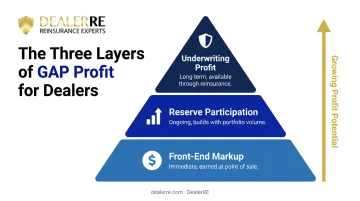
Dealers who move into reinsurance structures capture all three layers — plus a fourth: the underwriting profit itself, which third-party providers otherwise keep entirely.
How GAP Profit Flows Through the Dealership
Presentation and Enrollment
GAP profit begins at the F&I desk. The manager presents GAP as part of the product menu, typically tied to financing. The dealer cost and retail price are already set — profit is locked in at enrollment regardless of claims outcome.
The critical variable at this stage is penetration rate: what percentage of financed customers purchase GAP. Industry data places the national average around 28%, with a range of 20%–40% depending on the dealership and customer mix.
The difference between 20% and 40% penetration on 100 financed deals per month is 20 additional GAP sales — at a $378 average markup, that's roughly $7,500 in additional front-end profit monthly without changing anything about the product itself.
Program Administration and Reserve Accumulation
After a GAP contract is active, premiums are remitted to the administrator or carrier. In third-party programs, the carrier retains the underwriting margin, meaning the spread between total premiums collected and total claims paid stays with the carrier. The dealer receives only the agreed markup and any reserve participation. The majority of the underwriting profit stays with the third party.
In reinsurance structures, that dynamic reverses — the dealer's own entity captures the underwriting margin directly. How well that margin holds over time depends on what happens at the claim level.
Claim Events and Reserve Impact
When a customer files a claim, the carrier — or the dealer's reinsurance company — pays the deficiency between the insurance settlement and the remaining loan balance. In third-party structures, a filed claim doesn't claw back the markup already earned, but it does affect reserve performance.
Claim frequency shapes the actual return on a GAP program:
- High claim rates erode reserve balances and reduce participation distributions
- Low claim rates produce stronger reserve returns or underwriting profit payouts
- Program type determines who captures that upside — third-party carrier or dealer-owned reinsurance entity
That distinction is where the structural difference between standard GAP programs and reinsurance arrangements becomes most financially significant.
Key Factors That Shape Dealer GAP Profit
Loan Amount and Term
Higher loan balances and longer terms increase the retail price of each GAP contract, which increases the absolute dollar markup per deal.
Consider the contrast: a customer financing $18,000 over 36 months carries modest negative equity risk and a lower GAP price point. A customer financing $43,000 over 84 months — now nearly 30% of new vehicle originations per recent Experian data — carries a median negative equity of -$8,485 and commands a higher GAP price.
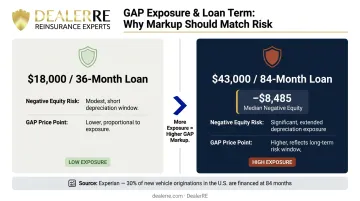
More exposure means a higher retail price, and a higher retail price means a larger markup per deal.
Program Provider and Contract Structure
Not all GAP programs are structured equally. Some providers offer:
- Better wholesale pricing
- More favorable reserve structures
- Dealer participation or back-end profit sharing
Dealers who negotiate their program terms or periodically audit their provider relationships often retain more income per contract than those who accept default terms.
Vehicle Type and Customer Profile
BHPH dealers face different risk dynamics than franchise dealers. Older vehicles with higher mileage depreciate faster and carry different insurance payout patterns — which affects claims frequency and reserve performance. CFPB data shows accounts with negative equity averaged an LTV of 119.3%, versus 89.1% for positive-equity trade-ins. That 30-point LTV spread is what creates consistent GAP demand across dealer types — and it's why understanding your customer profile directly affects how much profit each contract can generate.
The Reinsurance Advantage: Capturing Full Underwriting Profit on GAP
What Changes with Reinsurance
In a standard third-party program, the dealer earns the markup and the carrier keeps everything else. Every dollar of underwriting profit — the spread between premiums collected and claims paid — leaves the dealership permanently.
Reinsurance changes that equation entirely. When a dealer owns a reinsurance company, that entity assumes a portion of the risk on GAP contracts sold through the dealership. When claims are low, the profit that would have gone to the third-party carrier stays inside the dealer's own company instead.
This is what F&I and Showroom describes as treating dealer reinsurance as a "fifth business unit" — it generates returns independently of vehicle sales volume.
How It Works in Practice
The dealer's reinsurance entity receives ceded premiums and pays claims directly. In DealerRE's structure, premiums are held in a custodial account at a U.S.-based Trust Company. Withdrawals are permitted only for covered claims, limited professional fees, income taxes, and amounts exceeding required reserves — all requiring approval from the underlying A-rated carrier.
That structure carries real protection. Under DealerRE's admin obligor model (where the dealer's company is insured by A-rated carriers), customers' claims remain fully covered even as the dealer captures the underwriting economics.
The BHPH Case
For BHPH dealers, this structure addresses a loss they're already absorbing. Most BHPH operators informally write off remaining balances after a total loss to preserve the customer relationship — effectively providing GAP coverage for free.
Formalizing that through reinsurance converts a silent expense into a revenue line. DealerRE illustrates the shift directly: 150 GAP contracts at $499 each adds $75,000 to receivables for a service the dealer was previously giving away. The dealer files the claim with their own reinsurance company, processes the payment, and keeps the underwriting profit — no third-party GAP provider involved.
Control Beyond Profit
Dealer-owned reinsurance also gives dealers direct control over how their program performs. That means visibility into:
- Claims experience and loss ratios
- Product pricing at the F&I desk
- Program performance data across contracts
Those insights support smarter pricing decisions and a more durable income stream — one the dealer owns rather than rents from a third party.
DealerRE has helped more than 400 auto dealers establish and manage dealer-owned admin obligor reinsurance companies — including programs covering GAP and other F&I products — replacing third-party product income with the dealer's own underwriting returns.
Frequently Asked Questions
How do dealers profit from GAP insurance programs?
Dealers profit primarily through a retail markup on each GAP contract sold — typically around 151% above wholesale cost. In more advanced structures, additional income comes from reserve participation accounts and underwriting profit retained through a dealer-owned reinsurance program.
What is the typical profit margin on a dealer GAP program?
NCLC data shows an average dealer cost of approximately $251 and an average consumer price of $629 — a markup of roughly $378 per contract. The actual margin varies by loan size, program structure, and whether the dealer participates in back-end reinsurance, where returns can be significantly higher.
What is the difference between third-party GAP and a dealer-owned GAP program?
In a third-party program, the carrier retains all underwriting profit while the dealer earns only the front-end markup. In a dealer-owned structure, the dealer's own reinsurance company captures that underwriting margin — the spread between collected premiums and paid claims — instead of passing it to an outside carrier.
Can BHPH dealers benefit from a GAP program?
BHPH dealers benefit from GAP both as a profit tool and as a portfolio protection mechanism. Since the dealer carries the loan, any uninsured deficiency after a total loss is a direct balance-sheet loss. Reinsuring GAP turns that loss exposure into retained underwriting income while protecting the dealer's receivables.
Does a high claims rate reduce a dealer's GAP profit?
High claims erode reserve account returns and reduce underwriting income in dealer-owned structures, but they don't retroactively affect the front-end markup already earned. Penetration rate, program pricing, and portfolio composition each directly affect long-term returns and deserve ongoing attention.
How does reinsurance help dealers capture more GAP profit?
Reinsurance shifts the underwriting margin from the outside carrier to the dealer's own reinsurance company. That structural change gives dealers a second layer of income on every GAP contract sold — front-end markup plus back-end profit participation.