

Introduction
Every time a dealer sells a service contract or GAP policy through a third-party F&I provider, two profit streams leave the dealership quietly: underwriting profit and investment income. Neither shows up on the dealer's P&L. Both routinely dwarf the front-end commission the dealer actually keeps.
For most dealerships, this gap represents tens of thousands of dollars in annual profit transferred to third parties — money that could have stayed in-house.
Dealer-owned reinsurance exists to recapture both streams. Yet most dealers who explore it focus almost entirely on underwriting profit — without fully understanding how investment income works, when it becomes significant, or which stream matters more in early versus established programs.
Understanding the difference changes how you structure a program — and how you evaluate whether your current arrangement is actually working in your favor.
Key Takeaways
- Underwriting profit is what remains after claims and expenses — the core operational profit of your reinsurance program
- Investment income is earned by investing premium reserves; it's secondary but meaningful as reserves accumulate
- Third-party providers keep both profit streams; dealer-owned reinsurance lets you recapture them
- Underwriting profit is more controllable; investment income is passive and grows over time
- Prioritize underwriting profit first; investment income is a compounding return that grows as reserves build
Underwriting Profit vs. Investment Income: A Quick Comparison
Both revenue streams serve distinct roles in a dealer-owned reinsurance program. Understanding how they differ helps dealers set realistic expectations and build a more balanced profitability strategy.
| Factor | Underwriting Profit | Investment Income |
|---|---|---|
| Source | Net premiums minus claims paid and operating expenses | Returns from investing reserve funds held in the reinsurance entity |
| Dealer Control | High—directly influenced by claims adjudication, pricing, underwriting discipline | Moderate—depends on investment strategy and accumulated reserve size |
| Timeline | Realized over each contract period as claims settle and reserves release | Builds over time; more significant in mature programs (years 4+) |
| Primary Risk | High-frequency or high-severity claims eroding margins | Market conditions and interest rate volatility |

What Is Underwriting Profit in Dealer Reinsurance?
Underwriting profit is the money left over after your reinsurance company collects premiums from F&I product sales, pays approved claims, and covers operating costs. This is the core economic reason a dealer-owned reinsurance company exists: to stop transferring that margin to third-party carriers.
Calculation formula:
Earned Premiums − (Claims Paid + Loss Adjustment Expenses + Operating Expenses) = Underwriting Profit
Example: A dealer reinsurance company collects $500,000 in VSC premiums, pays $200,000 in claims and $75,000 in expenses, generating $225,000 in underwriting profit.
The Combined Ratio
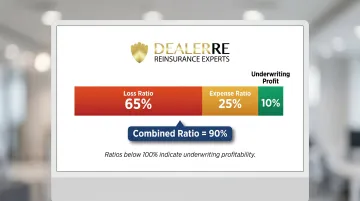
The combined ratio is the key performance metric for underwriting profitability. Calculate it by dividing total losses and expenses by earned premiums. Any result below 100% means the program is generating underwriting profit.
Two components:
- Loss ratio = (Claims Paid + Loss Adjustment Expenses) ÷ Earned Premiums
- Expense ratio = Operating Expenses ÷ Earned Premiums
According to Warranty Week analysis, extended service contract (ESC) insurers typically target combined ratios between 80% and 90%, with a 25% expense ratio and approximately 65% loss ratio yielding a 10% underwriting profit.
Why Claims Management Drives Underwriting Profit
Claims management is the single biggest lever for underwriting profit in dealer reinsurance. Dealers who control claims adjudication—reviewing whether claims are legitimate and reasonable before paying—retain far more of the premium dollar.
In DealerRE's admin obligor programs, dealers have full oversight of the claims process. This "controlling the claims experience" approach ensures claims are processed efficiently and fairly without unnecessary payouts. That oversight makes a measurable difference in how much of the premium dollar stays in your reinsurance company.
Third-Party vs. Dealer-Owned: Where Profit Flows
Third-party product model: The carrier keeps all underwriting profit. You earn a commission.
Dealer-owned reinsurance model: Underwriting profit flows back to your reinsurance company. This isn't a participation payment or commission—it's actual profit ownership.
Use Cases: Where Underwriting Profit Shows Up in Dealer F&I
The F&I products that generate the most consistent underwriting profit in dealer reinsurance include:
- Vehicle service contracts (VSCs) — highest volume and strongest profit potential in most programs
- GAP insurance — strong margins relative to claim frequency on newer vehicles
- Credit life/disability — lower volume but consistent underwriting results
- Ancillary protection products — tire & wheel, door ding, theft protection, and windshield coverage
VSCs alone represent 41.9% penetration on new vehicles according to NADA data cited by Colonnade Advisors, making them the largest single F&I product category driving reinsurance premium volume.
A dealer's own claims experience — not an industry average — determines whether their program runs profitably. Well-managed dealerships with lower mechanical failure rates and careful underwriting standards consistently outperform industry benchmarks.
What Is Investment Income in Dealer Reinsurance?
When premiums are collected, they're held in reserve to cover future claims. While those reserves sit in the reinsurance entity, they can be invested in approved instruments, generating a return above and beyond the underwriting result.
How it works: A dealer's reinsurance company accumulates reserves over time as contracts are written. The larger and older the program, the more capital sits in reserve — and the more investment income potential exists. It's a passive income stream that builds steadily as the program grows.
Investment Vehicles Used by Dealer Reinsurance Companies
DealerRE recommends that reserve funds be invested in very conservative government bonds earning short-term annual rates. These investments follow strict regulatory guidelines to ensure financial soundness and protect reserves from undue risk.
Once balance sheet cash exceeds 125% of unearned premiums, the company ownership can direct excess funds into more aggressive investment vehicles.
According to the NAIC Capital Markets Bureau, the U.S. insurance industry holds 60.4% of its $8.98 trillion in assets in bonds, with 95.1% of bond holdings rated investment grade. Conservative, fixed-income portfolios are the industry standard for reinsurance reserves.
Investment Income Is Separate from Underwriting Profit
Investment income does not appear in the combined ratio calculation. A reinsurer can experience an underwriting loss but still be profitable overall if investment income is sufficient — though this is not a sound long-term strategy.
Swiss Re sigma data (2008–2017 global average) shows non-life investment income averaged 9.8% of net premiums earned vs. an underwriting result of -1.1%. For the broader P&C industry, investment income has historically been the more stable profit stream.
Dealer-owned reinsurance operates in a more controlled environment than the broader P&C market — with a known product mix and defined customer base. Well-managed VSC/GAP programs can produce consistent underwriting profits, making investment income a supplement to, not a substitute for, sound underwriting performance.
Tax Planning Dimension
Investment income from reinsurance reserves is taxed differently than ordinary dealership income — which creates meaningful planning opportunities. Under IRC Section 831(b), companies with annual net written premiums at or below $2.8 million (2024 threshold) may elect to be taxed only on investment income, allowing underwriting profit to remain tax-deferred until distribution.
Note that investment income on accumulated reserves remains taxable under this election — see Mercer Capital's overview of dealer reinsurance for additional context. Dealers should consult with a qualified tax professional or their reinsurance program administrator to understand program-specific implications.
How Dealers Earn Investment Income Through Reinsurance
Investment income grows in direct proportion to two factors:
- Premium volume drives reserve size — the more contracts written, the larger the investable pool.
- Program age determines how much capital has built up — longer-running programs compound returns over time.
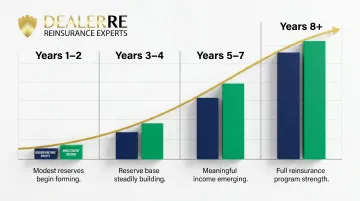
In the early years, investment income is modest. By year eight of a well-performing program, it becomes a meaningful secondary income stream.
The current elevated interest rate environment further boosts returns. AM Best reports that reinsurers are benefiting from elevated reinvestment yields and are positioned to earn "relatively elevated levels of interest income for several more years," with non-life portfolios concentrated in the 3-to-5-year duration range.
When distributions are taken, dealers have used that income to fund:
- Real estate purchases
- College education for family members
- Reinvestment back into the dealership
- Other personal and business financial goals
Which Profit Stream Should Dealers Focus On?
Underwriting profit and investment income are not competing goals — they work in sequence. Underwriting profit drives the program forward; investment income amplifies returns as reserves accumulate.
A dealer who chases investment returns without disciplined underwriting is skipping the foundation. Operational profitability must come first.
Factors That Determine Priority
Consider these factors when deciding where to focus attention:
Prioritize underwriting profit when:
- The program is new (years 1-3)
- Claims are trending higher than expected
- You're actively evaluating F&I product pricing and coverage terms
- Monthly F&I product volume is ramping up
Prioritize investment income when:
- The program is mature (years 4+)
- Reserves are substantial
- Underwriting margins are stable and predictable
- You're looking for long-term wealth-building strategies
Which Is Larger in Dollar Terms?
Knowing which stream is larger in dollar terms helps clarify where to direct attention — and the answer differs between the broader insurance market and dealer-owned programs specifically.
For the P&C industry overall, III data (2020-2024) shows net investment income ranged from $53.5B to $86.7B annually, while underwriting results swung from a $22.4B loss to a $26.2B gain. Investment income delivered the stability; underwriting was volatile.
For dealer-owned reinsurance — smaller, more controlled programs focused on VSC and GAP products — underwriting profit typically represents the larger share of total return in the first several years.
Casualty Actuarial Society research documents that extended service contract programs start with approximately 38% loss ratios that do not exceed 100% until the end of year four. This back-ended loss emergence pattern means early-year underwriting results appear favorable, but must be managed over the full contract lifecycle.
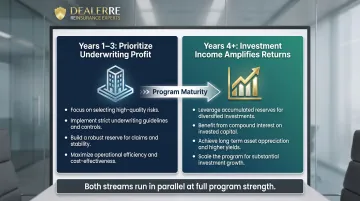
Practical recommendation: A well-run dealer reinsurance program generates meaningful underwriting profit within the first 2-3 years when claims are managed and volume is adequate. Investment income becomes increasingly significant in years 4+ as the reserve base grows — at that point, both streams are running in parallel and the program is operating at full strength.
How Dealers Capture Both Profit Streams with the Right Program Structure
The structure of the reinsurance program determines whether both profit streams are truly available to the dealer.
Admin Obligor vs. Traditional Participation Models
In a traditional participation or "DOWC" model, the dealer may share in profits but may not have full ownership of reserves or investment returns.
In an admin obligor reinsurance structure—the model DealerRE specializes in—the dealer's reinsurance company is both the obligor on the contract and the beneficiary of both underwriting profit and investment income, with A-rated insurers backing the risk.
In this structure, the dealer's reinsurance company assumes responsibility for fulfilling the obligations outlined in F&I contracts. A-rated insurers provide financial backing, so claims are paid even in the event of unexpected financial challenges — giving dealers direct ownership of both profit streams without sacrificing compliance or security.
That ownership only pays off when the program is administered well. How claims are handled, how compliance is managed, and how performance is reported all determine how much underwriting profit the dealer actually keeps.
Program Administration Quality Protects Underwriting Profit
Accurate claims adjudication, compliance with product terms, transparent financial reporting, and consistent performance analysis all protect the underwriting margin.
DealerRE's full-service administration model includes:
- Claims adjudication — Partnered with Assured Vehicle Protection (AVP) for consistent adjudication
- Compliance management — Legal forms, filings, tax returns, renewals
- Performance reports — Detailed analysis and optimization insights
- Financials/bookkeeping — Monthly financial statements and transparency
Want to understand how much underwriting profit and investment income you may currently be leaving with a third-party carrier? DealerRE offers a dealership analysis to help you evaluate your current F&I program and identify recapture opportunities. Contact DealerRE at (804) 824-9533 to learn more.
Frequently Asked Questions
What is underwriting profit in insurance?
Underwriting profit is the money remaining after an insurance or reinsurance company pays all claims and operating expenses from collected premiums. It represents the core operational profit of the program, tracked separately from any investment returns.
How do you calculate underwriting profit?
The formula is: Earned Premiums minus (Claims Paid + Loss Adjustment Expenses + Underwriting Expenses) = Underwriting Profit. A combined ratio below 100% indicates an underwriting profit.
Is investment income included in the underwriting profitability equation?
No. Investment income is explicitly excluded from the underwriting profit calculation. The two are separate line items—underwriting profit measures operational performance, while investment income is tracked separately and added to arrive at overall profitability.
What is the difference between underwriting and reinsurance?
Underwriting is the process of evaluating and accepting risk in exchange for a premium; reinsurance is when one insurer transfers a portion of that risk to another company. In dealer-owned reinsurance, the dealer's company acts as the reinsurer and captures the underwriting profit directly.
How do reinsurers make money?
Reinsurers generate revenue through two streams: underwriting profit and investment income. In a dealer-owned reinsurance model, both flow to the dealer rather than to a third-party carrier.
What is a reinsurance profit commission?
A profit commission is an agreement where the reinsurer shares a percentage of underwriting profit back to the ceding party once losses are settled. In an admin obligor structure, the dealer's company retains all profit directly—no commission arrangement needed.