
Introduction
Debt cancellation agreements (DCAs) show up in F&I offices daily—yet they remain one of the most mishandled products in the dealership. The "debt cancellation fee" is what buyers pay upfront for this protection: a charge added directly to the vehicle sales contract that cancels or reduces the outstanding loan balance when a specific triggering event occurs, such as death, disability, or involuntary unemployment.
Dealers and consumers routinely confuse DCAs with GAP insurance or debt suspension agreements—a distinction that matters both for proper disclosure and for compliance. According to CFPB enforcement data, auto lenders face aggressive scrutiny for abusive add-on product practices, including financing void products and withholding refunds.
That scrutiny lands on the dealership too.
What follows covers how DCAs work, how fees are structured, how they differ from related products, and what every F&I office needs to get right before presenting them to a customer.
TLDR
- A DCA cancels all or part of your auto loan balance if a triggering event—death, disability, or involuntary unemployment—occurs
- The debt cancellation fee is added to your contract upfront (lump sum) or rolled into monthly payments
- DCAs are banking products regulated by the OCC and state finance codes—not insurance products
- DCAs differ from GAP (total loss coverage) and debt suspension (temporary payment pause)—knowing the distinction matters
- Dealers who structure DCAs through dealer-owned reinsurance capture the underwriting profit directly, instead of passing it to third-party providers
What Is a Debt Cancellation Agreement in a Vehicle Sales Contract?
A debt cancellation agreement is a contractual arrangement between a lender and borrower in which the lender agrees to cancel all or part of the outstanding loan balance when a specified triggering event occurs. Under OCC Part 37, DCAs are classified as banking products—not insurance—and are regulated at the federal level by the Office of the Comptroller of the Currency.
In a vehicle sales context, the DCA is presented during the F&I process as an optional add-on to the auto loan. It appears as a separate line item fee in the vehicle sales contract.
Common Triggering Events
According to the CFPB, the most common events that activate a DCA include:
- Death of the borrower
- Total and permanent disability
- Involuntary job loss (not voluntary resignation)
- Critical illness
- Natural disaster or military deployment (in some agreements)
Each contract defines these events precisely, and exclusions apply—pre-existing conditions, waiting periods, and voluntary job changes often void coverage.
Two Coverage Structures
DCAs come in two forms:
- Full cancellation: The lender wipes out the entire remaining loan balance upon a triggering event.
- Partial cancellation: The lender cancels only a defined portion or a set number of monthly payments.
Buyers need to confirm which structure applies before signing—full cancellation and a three-month payment waiver are very different outcomes. That distinction also matters when comparing DCAs to credit insurance, which is a separate product category entirely.
How DCAs Differ from Credit Insurance
Both DCAs and credit insurance are sold at dealerships and offer hardship protection. However:
- DCAs are regulated as banking products (overseen by the OCC federally and some state banking regulators)
- Credit insurance is regulated as an insurance product by state insurance departments
The regulatory gap has real consequences: DCAs are handled directly by the lender, while credit insurance routes claims through a third-party insurer. That difference shapes pricing, required disclosures, and how quickly claims get resolved.
How Debt Cancellation Fees Work in Auto Lending
The debt cancellation fee is the cost structure embedded in the DCA. It's typically calculated as a percentage of the loan amount or as a flat fee based on the vehicle's price range. While fee structures vary by lender and state regulations, Texas OCCC limits DCA fees to 5% of the financed amount.
Two Payment Methods
- Lump-sum upfront: Added to the financed amount, so you pay interest on the fee across the full loan term — higher total cost, simpler contract structure.
- Periodic per-payment fee: Spread across monthly payments, keeping costs visible but extending your exposure for the life of the loan.
Lifecycle of a DCA in a Vehicle Sales Contract
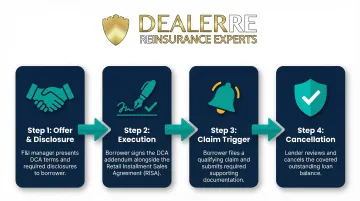
Step 1 — Offer and Disclosure
The F&I manager presents the DCA during deal-closing, discloses the cost and key terms, and the buyer elects to accept or decline in writing. OCC Part 37 mandates that lenders disclose the purchase is optional and won't affect credit application approval.
Step 2 — Execution
The DCA addendum is signed alongside the purchase contract and retail installment sales agreement (RISA). The fee is recorded and the agreement becomes binding.
Step 3 — Claim Trigger
If a qualifying hardship event occurs, the borrower (or estate) files a claim with the lender, providing documentation of the triggering event—death certificate, disability determination, or involuntary termination notice.
Step 4 — Cancellation
Upon claim approval, the lender cancels the covered portion of the remaining balance. Unlike credit insurance, the lender handles this directly without a third-party insurer processing the claim.
Early Payoff and Refunds
Not every DCA ends with a hardship claim. If you pay off your vehicle loan early, you're typically entitled to a pro-rated refund of the unearned DCA fee.
OCC regulations require lenders to calculate refunds using a method at least as favorable to the customer as the actuarial method. Refund eligibility still varies by contract terms and state law, so check your contract's refund calculation method before signing.
Tax Treatment
Under IRS rules, amounts cancelled under a DCA are generally treated as taxable Cancellation of Debt (COD) income, triggering Form 1099-C for cancellations of $600 or more.
Two exceptions apply — insolvency and active bankruptcy — but outside those circumstances, the cancelled balance counts as ordinary income. Borrowers should consult a tax professional to understand their specific obligations.
DCA vs. GAP Insurance vs. Debt Suspension: Clearing Up the Confusion
The most damaging confusion in F&I offices is conflating DCAs with GAP insurance. Each product responds to a completely different trigger event — and mixing them up leaves borrowers unprotected.
DCA vs. GAP: The Critical Distinction
GAP (Guaranteed Asset Protection) covers the "gap" between what your vehicle is worth (actual cash value) and what you still owe after a total loss or theft. According to the CFPB, GAP is triggered by a physical loss event tied to the vehicle's condition.
A DCA cancels the loan balance based on a personal hardship event—death, disability, or involuntary unemployment. It's tied to the borrower's circumstances, not the vehicle's condition.
If your car is totaled in an accident, GAP covers the deficiency between the insurance payout and the loan balance. If you become permanently disabled, a DCA cancels your remaining loan obligation. The triggering events are mutually exclusive.
Debt Suspension Agreements: The Third Option
A debt suspension agreement temporarily postpones scheduled monthly payments during a qualifying hardship period. Unlike a DCA, debt suspension does not reduce total debt—it only delays repayment. Once the hardship ends, you must repay the full loan, including all suspended payments.
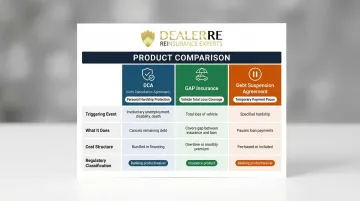
Side-by-Side Comparison
| Product | Triggering Event | What It Does | Cost Structure | Regulatory Classification |
|---|---|---|---|---|
| DCA | Death, disability, involuntary unemployment | Permanently cancels loan balance | Flat fee or % of loan | Banking product (OCC) |
| GAP | Vehicle total loss or unrecovered theft | Covers gap between ACV and loan balance | Flat fee or monthly premium | Insurance product (state) |
| Debt Suspension | Specified hardships | Temporarily pauses payments | Periodic fee | Banking product (OCC) |
Why This Confusion Is Costly
A borrower who buys a DCA thinking it works like GAP may be unprotected after a total-loss accident. Conversely, a borrower who declines a DCA because they think their GAP coverage already protects them may be exposed if they die or become disabled. That borrower exposure becomes a dealer liability — dealers who conflate these products face CFPB enforcement risk for misleading disclosures.
Why Auto Dealers Should Understand DCAs
DCAs represent an established F&I revenue opportunity. According to Haig Partners data, publicly owned auto dealerships reported average F&I gross profit of $2,501 per vehicle retailed (PVR) in Q4 2024, climbing to $2,515 PVR by Q2 2025. Dealers who present DCAs as part of a structured F&I menu increase per-deal gross profit.
The Third-Party Provider Profit Trap
Most dealers who offer DCAs through third-party providers surrender the majority of the product's profit margin to that vendor. Dealers who structure their F&I programs through a dealer-owned reinsurance model—such as those supported by DealerRE—can capture far more of the income generated by DCAs and similar products. This turns a vendor profit into income the dealer keeps.
DealerRE's model gives dealers direct control over that income through three key mechanisms:
- Reserve premiums inside their own reinsurance company
- Capture 100% of underwriting profits (total premiums minus claims paid)
- Maintain control over the customer claims experience rather than deferring to a third party
Compliance Responsibility
Dealers are the point of sale and are responsible for ensuring DCAs are presented accurately, disclosed properly, and not misrepresented. The CFPB's Fall 2024 Supervisory Highlights cited auto servicers for unfair practices related to add-on products, including failing to ensure consumers received refunds upon early loan termination and financing void products on salvage-title vehicles. Proper training and documentation are essential for any dealer offering these products.
DealerRE provides full-service administration—training, claims adjudication, compliance management, legal forms, and financial reporting—for dealers who want to run a tighter F&I operation. Call (804) 824-9533 to get started.
Common Misconceptions and When a DCA May Not Be the Right Fit
The Automatic Cancellation Myth
The most damaging misconception: signing a vehicle sales contract with a DCA means your loan is automatically cancelled in any hardship. In reality, cancellation only applies to the specific triggering events listed in the agreement. Most DCAs contain eligibility restrictions:
- Pre-existing medical conditions may void disability claims
- Waiting periods (often 30-90 days) before coverage begins
- Voluntary resignation does not qualify (only involuntary layoff)
- Documentation requirements can be strict and time-sensitive
When a DCA May Not Provide Good Value
Not every buyer benefits equally from a DCA. The CFPB advises evaluating existing coverage before purchasing auto loan debt cancellation products — buyers carrying term life or long-term disability insurance may already have broader protection at a lower relative cost.
Financing cost matters too. Compare the DCA against the full loan term, not just the flat fee. If you finance the lump-sum cost, you'll pay interest on it for the entire loan period, driving up the total cost over the loan term.

When Dealers Should Exercise Caution
Product fit matters as much on the dealer side. Two situations call for extra scrutiny:
- Short loan terms or high down payments: Buyers who owe close to vehicle value already have limited exposure — a DCA adds cost without meaningful benefit.
- High-subprime BHPH buyers: Adding a fee that strains payment capacity actively undermines loan performance. The CFPB found abusive practices where finance companies charged consumers for optional add-on products they didn't agree to purchase, taking unreasonable advantage of their inability to protect their interests.
Frequently Asked Questions
What is a debt cancellation fee in a vehicle sales contract?
It's the cost you pay for a debt cancellation agreement (an optional add-on that cancels all or part of your remaining auto loan balance if a qualifying event (death, disability, involuntary unemployment) occurs). It appears as a separate line item in your vehicle sales contract and can be paid as a lump sum or added to monthly payments.
What is the difference between a debt cancellation agreement and GAP insurance?
GAP covers the financial shortfall after a vehicle total loss (vehicle value vs. loan balance), while a DCA cancels the loan balance due to a personal hardship event such as death or disability. They protect against entirely different scenarios and are not interchangeable. Depending on your risk exposure, you may need both.
Is a cancellation of debt a good thing?
When a DCA is triggered legitimately, it eliminates a financial obligation you can no longer meet—a real benefit in a crisis. That said, weigh the upfront cost against your actual risk profile and existing coverage before purchasing, and know that cancelled debt may be taxable income.
Are debt cancellation fees refundable if I pay off my loan early?
Most DCAs entitle you to a pro-rated refund of the unearned portion of the fee upon early payoff, calculated using the actuarial method or the Rule of 78s, depending on your contract. However, terms vary by contract and state law. Confirm refund eligibility and calculation method before signing.
How badly does surrendering a car hurt your credit?
According to Experian, both voluntary surrender and repossession remain on your credit report for seven years from the original delinquency date and carry similar severe score impacts. A DCA, if triggered by qualifying circumstances, can prevent the need for surrender entirely by cancelling the remaining balance.
Can dealers profit from offering debt cancellation agreements?
Yes, DCAs generate F&I income for dealers. However, dealers who rely on third-party providers typically share or surrender most of that profit. Dealers who structure these products through a dealer-owned reinsurance program (such as those offered by DealerRE) retain significantly more of the revenue per deal, capturing 100% of underwriting profits instead of sending them to insurance companies. Contact (804) 824-9533 to explore dealer-owned reinsurance options.