Introduction
Most dealers selling third-party vehicle service contracts unknowingly hand over significant underwriting profits through reinsurance. When you sell a VSC through a third-party provider, you capture the initial markup — but the provider keeps the premium reserve not used to pay claims.
That unused reserve becomes their underwriting profit, not yours. Over five to ten years, this can represent hundreds of thousands or even millions of dollars you never see.
This guide covers how reinsurance integrates into VSC contracts, how profit flows work, what structure options exist, and how to take action. Whether you run a franchise dealership, an independent lot, a retail operation, or a Buy Here Pay Here (BHPH) store, reinsurance is accessible to any dealership selling 30+ vehicles monthly.
TL;DR
- VSC premiums include an admin fee and a premium reserve; without reinsurance, third-party providers keep all unused reserves
- Reinsurance lets you own the entity that captures unused reserves as underwriting profit
- Premium flows: Customer → Obligor → Dealer-owned reinsurance company — earned reserves become your profit
- Admin-obligor structures qualify for IRC §831(b) tax treatment — only investment income is taxed, not underwriting profits
- This guide covers how the structure works, what the tax advantages are, and how to set up your own dealer-owned reinsurance company
What Is a VSC Contract and Why Does It Matter for Dealers?
A Vehicle Service Contract (VSC) is a contract between a customer and an obligor—typically a VSC provider, dealer, or insurer—that covers the cost of specified vehicle repairs after the manufacturer warranty expires. The Federal Trade Commission defines auto service contracts as optional agreements sold separately to perform or pay for certain repairs. Unlike manufacturer warranties (included in the vehicle price), VSCs are purchased separately and are not technically warranties under federal law.
VSCs differ from Mechanical Breakdown Insurance (MBI):
- MBI is regulated by state insurance departments, with pricing oversight
- VSCs are not rate-regulated, meaning dealers set their own retail prices
The Anatomy of VSC Pricing
Every VSC sale has two main components:
- Admin fee: Roughly 20% or less of the contract price, covering administrator costs, insurer fees, agent commissions, roadside assistance, and operational overhead
- Premium reserve: The remaining 80%+, set aside to pay future claims
NAIC Model #685 requires providers to maintain reserves of at least 40% of gross premiums collected, net of claims paid. What happens to unused reserves is the core financial question in any reinsurance arrangement.
The Obligor's Role
The obligor is the entity legally responsible for paying claims. In third-party VSC arrangements, the obligor is the warranty company, and they keep unused reserves as profit. In dealer-owned reinsurance, your company becomes the obligor (or assumes the obligor's risk via cession), meaning you capture those profits instead.
Market Opportunity
The VSC industry reached $40.2 billion in 2022. The numbers show why dealer-owned reinsurance is worth structuring correctly:
- Average retail price: $3,500–$4,000 for five-year coverage
- VSC penetration rate (new vehicles): 45.7% (NADA Data)
- VSC penetration rate (used vehicles): 47.6% (NADA Data)
- Statutory reserve floor: 40% of gross premiums collected
That gap between the 40% floor and actual loss ratios is where the underwriting profit lives.
What Is Reinsurance and How Does It Integrate Into VSC Contracts?
Reinsurance Defined
The NAIC defines reinsurance as a transaction where a primary insurer transfers all or part of its risk—and corresponding premiums—to a second insurance entity (the reinsurer) in exchange for the reinsurer assuming responsibility for covered losses. In the VSC context, this means the obligor transfers VSC risk directly to your dealer-owned reinsurance company.
Risk-Shifting and Risk-Distribution
For a reinsurance arrangement to qualify as insurance under IRS standards, it must demonstrate:
- Risk-shifting: A person facing economic loss transfers financial consequences to the insurer
- Risk-distribution: The insurer spreads risk across many contracts (the law of large numbers), reducing the chance that a single costly claim exceeds premiums collected
IRS Private Letter Rulings (PLR 201732021 and PLR 201314020) confirm that dealer-issued VSCs constitute insurance contracts for federal income tax purposes when the VSC meets aleatory contract and risk-distribution standards. These rulings confirm that VSCs depend on uncertain events and distribute risk across a large pool of insureds.
The Admin-Obligor Model
In this structure, your reinsurance company becomes the obligor—or assumes the obligor's risk via cession. Your dealer-owned entity indemnifies claims directly, giving you control that passive offshore structures simply don't offer.
The Cession Mechanism
When a VSC is sold:
- The obligor receives the full premium
- Admin fees are deducted
- The remaining premium reserve is ceded to your dealer-owned reinsurance company under a reinsurance agreement
- If claims never materialize—or come in below reserve—your reinsurer retains the difference as underwriting profit
The Role of the A-Rated Backup Insurer
That underwriting profit doesn't sit unprotected. Even when you own the reinsurance company, a licensed A-rated insurer backs the program, covering three critical bases:
- Consumer protection: Policyholders remain covered even if your reinsurance company faces shortfalls
- Regulatory compliance: The A-rated carrier satisfies state licensing and solvency requirements
- Loss insulation: If your reinsurance company cannot meet obligations, the direct writing insurance company remains liable—limiting your exposure to formation costs plus accumulated earnings
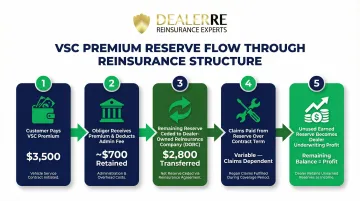
How VSC Premium Reserves Flow Through a Reinsurance Structure
The Money Flow
- Customer pays VSC premium (e.g., $3,500)
- Obligor receives premium and deducts admin fee (~$700)
- Remaining premium reserve ($2,800) is ceded to your dealer-owned reinsurance company
- Claims are paid from the reserve over the contract term
- Unused earned reserve becomes underwriting profit to you
Financial Impact: A Realistic Example
Assumptions:
- 20 VSCs sold monthly
- $800 reserve per contract (after admin fees)
- 50% loss ratio (half of reserves used for claims)
Annual Calculation:
- Monthly premium reserve ceded: 20 × $800 = $16,000
- Annual reserve ceded: $16,000 × 12 = $192,000
- Claims paid (50% loss ratio): $96,000
- Annual underwriting profit: $96,000
Five-Year Projection:
- Total reserve ceded: $960,000
- Total claims paid: $480,000
- Five-year underwriting profit: $480,000
Investment income on reserves held in your trust account adds a secondary return on top of underwriting profit.
How Contracts 'Earn' Over Time
A 12-month VSC earns 1/12th per month. As the contract earns and claims remain below reserve, that earned portion becomes underwriting profit. This means your trust account builds steadily over time, not all at once.
Claims Management in the Admin-Obligor Structure
How that reserve gets spent is just as important as how it builds. Because you control claims adjudication through your reinsurance company, you can:
- Approve claims faster than third-party providers
- Reduce customer friction
- Build loyalty and repeat business
- Direct repairs to your service facility, keeping all revenue in your ecosystem
Third-party VSC providers make claims decisions independent of your customer relationships, with no stake in your dealership's reputation.
Compliance Requirements
The reinsurance trust account is:
- Segregated from your dealership's operating funds
- Managed by a professional administrator (such as DealerRE)
- Required to maintain adequate reserves per regulatory guidelines
- Subject to monthly financial statements and annual reporting
Your administrator manages the financials, state filings, tax returns, and renewals — so your program stays clean without adding administrative burden to your team.
Types of Dealer-Owned Reinsurance Structures for VSC Programs
Dealers entering reinsurance have three primary structures to consider. Each carries different levels of control, tax treatment, and profit potential — choosing the right one depends on your risk tolerance and long-term goals.
Controlled Foreign Corporation (CFC)
A CFC is domiciled offshore (commonly Turks and Caicos Islands) but taxed as a US company. Under IRC §957, a CFC is any foreign corporation where more than 50% of voting power or stock value is owned by US shareholders.
Key Features:
- All assets held in US financial institutions
- Dealer can invest premiums and borrow against the trust account (subject to approval)
- Funds can be used for capital improvements, floor planning, or business expansion
- Becomes your proprietary book of business with investment flexibility
Best for: Dealers who want offshore domicile benefits while maintaining US tax treatment and hands-on investment control.
Dealer-Held Warranty Company (DHWC) / Admin-Obligor
DealerRE specializes in this structure. The dealer owns the obligor entity (administered by a third party), meaning your company is directly responsible for VSC performance. The obligor is typically treated as an insurance company for tax purposes.
Key Features:
- Most direct control over VSC product design and customer claims experience
- Captures 100% of underwriting profits
- Administrator handles claims adjudication, billing, tax returns, and compliance
- Backed by A-rated insurers for consumer protection
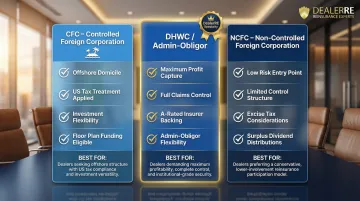
Best for: Dealers who want maximum profit capture and full control over their F&I product experience.
Non-Controlled Foreign Corporation (NCFC)
The NCFC is a low-risk, low-return structure. Money is domiciled offshore, and the dealer has limited investment control. Premiums may be subject to excise taxes under IRC §4371 — a 1% tax on reinsurance issued by foreign insurers, with exemptions available under qualifying tax treaties. Dividends can be repatriated as surplus.
Best for: Very risk-averse dealers who prioritize simplicity over maximizing underwriting returns.
The Profit and Tax Advantages of VSC Reinsurance for Dealers
Profit Shift
Third-party warranty companies profit from premium reserves not used to pay claims. Reinsurance lets you capture that profit instead. According to DealerRE's internal data and industry benchmarks, the average VSC loss ratio ranges from 50% to 70%, meaning 30-50% of premiums become underwriting profit.
IRC §831(b) Tax Election
For taxable years beginning in 2026, the IRS inflation-adjusted premium limit for small insurance companies is $2.9 million in net premiums (per IRS Rev. Proc. 2025-32). Companies below this threshold may elect to be taxed only on investment income, not premium income.
Instead of paying ordinary income tax on underwriting profits immediately, those profits accumulate in your reinsurance company's trust account with reduced tax exposure. This is why larger dealers have historically used reinsurance—and why it's now accessible to smaller dealers.
To qualify for §831(b), no more than 20% of net written premiums can come from any one policyholder, and the company must meet specific ownership concentration tests.
Additional Investment Income Potential
Premiums sitting in the trust account can be invested (in compliance with program guidelines). Initially, funds are invested conservatively in government bonds. Once balance sheet cash exceeds 125% of unearned premiums, you can direct excess funds into more aggressive investments.
DealerRE clients use earned income to:
- Purchase real estate
- Fund children's education
- Reinvest in dealership operations
- Acquire watercraft or other personal assets
Customer Retention and CSI Benefits
When you own the claims experience, you approve claims more quickly and generously, directly improving customer satisfaction scores and repeat business. Third-party VSC providers have no loyalty to your customer relationships—you do.
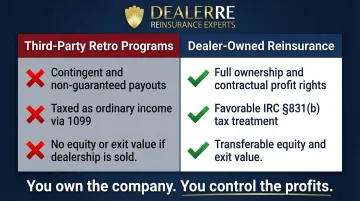
Contrast with Retro Programs
Some third-party VSC companies offer profit participation (retro) programs. These are:
- Contingent on volume and the relationship—neither guaranteed nor contractual
- Taxed as ordinary income via 1099, at your highest marginal rate
- Worthless if you sell the dealership or reduce volume—no equity, no exit value
Full dealer-owned reinsurance has none of these limitations. You own the company, control the profits, and benefit from favorable tax treatment.
F&I Profit Contribution Data
That profit advantage compounds when you consider how much F&I already contributes to dealer earnings. AutoNation reported in 2024 that F&I comprised only 5.0% of total revenue but contributed 28.0% of total gross profit, with an F&I gross profit per vehicle retailed (PVR) of $2,769. Capturing underwriting profits through reinsurance amplifies that return further.
How to Get Started with a VSC Reinsurance Program
Evaluate Your Dealership
Minimum Requirements:
- Selling 30+ vehicles monthly
- Existing F&I product penetration (or willingness to develop it)
- Commitment to professional administration and compliance
You don't need to be a high-volume dealer to benefit. Many dealers selling 30-50 cars monthly build meaningful trust accounts within 3-5 years.
Setup Process
What's Involved:
- Form your reinsurance company — typically domiciled offshore with US-based trust accounts
- Select a qualified administrator, such as AVP, to manage ongoing operations
- Draft the reinsurance agreement between the obligor and your new entity
- Engage a backup A-rated insurer for consumer protection and catastrophic loss coverage
- Train your F&I team on VSC sales and the reinsurance value proposition
What DealerRE Handles:
- All legal forms, filings, tax returns, and renewals
- Entity formation and licensing coordination
- Compliance monitoring and regulatory adherence
- Monthly financial statements and annual reports
- Periodic owner meetings to review operations
- F&I training (online and in person)
The Cost of Inaction
Once the setup process is complete, timing becomes the only variable that matters. Consider two dealers with the same opportunity. Dealer A sets up a reinsurance company and begins capturing underwriting profits immediately. Over five years, they build a $500,000 trust account with favorable tax treatment.
Dealer B delays, continuing to send underwriting profits to third-party warranty companies. After five years, they have nothing to show for it — no equity, no trust account, no tax advantage.
The difference between these outcomes is when they started. Each month of delay is another month of underwriting profit paid to someone else. The sooner you act, the sooner that money stays with your dealership.
Frequently Asked Questions
What are reinsurance contracts?
A reinsurance contract is an agreement where an insurer (or obligor) transfers a portion of its risk and associated premium to a second insurance entity (the reinsurer), which then covers qualifying losses under the agreed contract terms.
What is VSC insurance?
A VSC (Vehicle Service Contract) is a service contract, not an insurance policy. However, under IRS Private Letter Rulings, dealer-issued VSCs qualify as insurance contracts for tax purposes when structured to demonstrate risk-shifting and risk-distribution.
What is the 9-month rule for reinsurance contracts?
The 9-month rule refers to NAIC SSAP No. 62R (paragraph 24), which states that a reinsurance contract must be finalized, reduced to written form, and signed within nine months of the effective date, or it becomes subject to retroactive accounting treatment.
What are the four types of reinsurance?
The four primary types are proportional (quota share and surplus share) and non-proportional (excess of loss and stop loss). Dealer VSC programs typically use quota share structures, where a fixed percentage of premium and risk is ceded to the dealer's reinsurance company.
How much should a VSC cost?
VSC pricing varies based on vehicle type, mileage, coverage level, and term length. A typical VSC runs $3,500 to $4,000 for five years of coverage. Unlike MBI policies, VSC prices are not regulated, so dealers set their own retail price.
Is VSC the same as GAP?
No. A VSC covers mechanical repair costs, while GAP (Guaranteed Asset Protection) covers the difference between a vehicle's insurance payout and the remaining loan balance in a total loss. Dealers can reinsure both products through a single dealer-owned reinsurance structure.