Reinsurance changes that dynamic. It allows dealers to capture those profits by setting up their own reinsurance entity and assuming a portion of the risk on the products they already sell.
For many dealers, the idea of starting a reinsurance company sounds intimidating or overly complex. But interest is growing quickly across franchise powersports stores, independent dealers, and multi-location groups alike as the industry catches up to the automotive sector, where reinsurance has become standard practice among high-performing dealers.
This guide walks through what a powersports dealer reinsurance program actually is, what decisions you need to make before launching, and the concrete steps involved in getting started.
Key Takeaways
- A reinsurance program lets dealerships capture underwriting profits from F&I products they already sell instead of sending those profits to third parties
- Admin obligor, CFC, and DOWC structures each carry different risk, tax, and control implications — choose carefully
- Setup covers readiness assessment, structure selection, product eligibility, legal compliance, and F&I team training
- Your choice of reinsurance partner determines how much profit you keep — and how smoothly the program runs
What Is a Powersports Dealer Reinsurance Program?
A powersports dealer reinsurance program is an arrangement where a dealership sets up its own reinsurance company that assumes a portion of the risk on the F&I products it sells — such as vehicle service contracts, tire and wheel protection, and appearance coverage. Instead of leaving underwriting profits with a third-party provider, the dealer's reinsurance entity receives those premiums and retains whatever remains after claims are paid.
Here's how the money flows in practice: when a customer purchases a service contract for $500, roughly $100 covers administration fees and commissions. The remaining $400 flows into reserves held by the reinsurance entity to pay claims over the life of the contract — typically 2-5 years for powersports products. Whatever is left after contracts expire belongs to the dealership, available to reinvest, distribute, or put back into the business.
Three main structures are used to set up these programs, each with distinct legal and financial implications:
- Admin obligor: The dealer's reinsurance company is backed by an A-rated insurer, offering stability with less direct risk exposure
- Controlled Foreign Corporation (CFC): An offshore entity that reinsures F&I contracts issued by a licensed third-party obligor, often electing to be taxed as a U.S. domestic insurance company under IRC Section 953(d)
- Dealer-Owned Warranty Company (DOWC): A domestic U.S. corporation where the dealer is the direct obligor, issuing contracts and taking full legal responsibility for claims
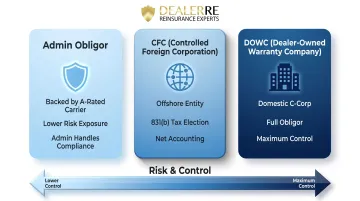
The right structure depends on your volume, risk tolerance, and tax situation — factors that determine both your upfront setup and how profits are treated long-term.
What to Know Before You Launch
Reinsurance Is a Long-Term Wealth-Building Strategy
Reserves accumulate over the life of each contract, and investment income compounds considerably over time — this isn't a quick income boost. A mid-size dealership selling 150 units per month with 65% product penetration and an $800 average premium could generate $936,000 in annual premium.
At a 35% blended loss ratio, that translates to roughly $608,400 per year in retained premium — accumulating over $3 million in value over five years with modest investment returns. Consistent volume is what makes those numbers move.
Early Administrative Complexity Is Often Underestimated
Setting up a reinsurance entity is more involved than most dealers expect. The administrative workload typically includes:
- Legal entity filings and ongoing compliance obligations
- Claims adjudication processes and dispute management
- Financial reporting, tax returns, and annual renewals
Most dealerships don't have internal staff equipped to handle all of this. That's why partnering with a full-service administrator — one that manages legal forms, filings, and financials on your behalf — makes a meaningful difference in program stability.
Volume Requirements Vary by Structure
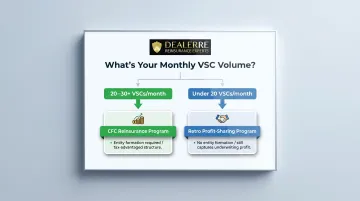
Consistent F&I product volume is what makes a reinsurance program financially viable. Most administrators require 20–30 vehicle service contracts per month (roughly 300–350 annually) as the minimum threshold for a controlled foreign corporation (CFC) structure.
Many powersports dealers sell fewer than 100 retail units per month — and often fewer than 30 service contracts. For those stores, retro profit-sharing programs are a better fit. They require no entity formation and still allow dealers to capture underwriting profit without hitting the CFC volume floor.
Why Powersports Dealers Are Turning to Reinsurance
Capturing Underwriting Profit
Under a traditional third-party arrangement, the administrator keeps the underwriting profit and investment income on every contract sold. With reinsurance, that profit stays with the dealer.
Per-vehicle F&I revenue (PVR) in powersports grew from the low-$500s in 2022 to nearly $700 per unit in 2025, indicating substantial premium volume that could be captured through reinsurance rather than left with third parties.
Control Beyond Just Profit
Reinsurance gives dealers more than financial upside. It allows them to:
- Manage claims directly, improving customer satisfaction and reducing disputes
- Customize F&I product offerings to match their customer base
- Make underwriting decisions based on their own knowledge of their market
Tax Planning Advantages
Reinsurance programs carry real tax advantages. Key mechanisms include:
- 831(b) election: CFCs can exclude underwriting profit from taxable income, paying tax only on investment income annually
- Capital gains treatment: Cash disbursements from the reinsurance entity are taxed at capital gains rates rather than ordinary income rates
- Investment income control: Retained premiums can be invested, generating additional ROI within the structure
Important: Dealers must consult a qualified tax advisor for specifics applicable to their situation. Tax treatment varies significantly by structure and individual circumstances.
An Adoption Gap Creates Opportunity
Those financial advantages compound over time — which makes market timing worth noting. Powersports currently trails the automotive industry in structured profit sharing and reinsurance participation. Dealers who enter now accumulate reserves and loss-ratio history before competition in the space intensifies — a meaningful head start that later entrants won't have.
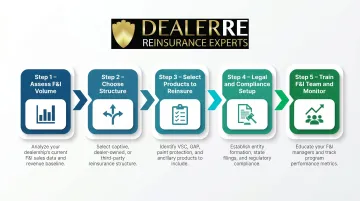
How to Start a Powersports Dealer Reinsurance Program
Getting started requires deliberate sequencing. Rushing through structure selection or skipping proper legal setup creates compliance and profitability problems that are expensive to correct later.
Step 1: Assess Your Dealership's F&I Volume and Readiness
Review your current F&I product sales data:
- Which products are selling consistently (VSCs, appearance protection, tire and wheel, prepaid maintenance, GAP)?
- What is your average premium per contract?
- What is your monthly volume?
This baseline determines whether your reserves will be large enough to make reinsurance financially meaningful.
Identify internal ownership:
- Who in your organization will own and manage the reinsurance program on an ongoing basis?
- Does your current F&I team have the training and menu structure to sustain or grow product penetration rates?
Step 2: Choose the Right Program Structure
Admin Obligor:
The dealer's reinsurance company is backed by an A-rated carrier, offering stability with less direct risk exposure. The administrator handles licensing, compliance, and claims processing, allowing the dealer to focus on ownership and wealth building.
Best for: Dealers seeking lower compliance burden and reduced direct risk.
CFC (Controlled Foreign Corporation):
An offshore corporation typically domiciled in Turks and Caicos that reinsures F&I contracts using net accounting (only the wholesale portion of premium flows into the captive). The 831(b) election is available for companies with less than approximately $2.3-2.8 million in annual written premium.
Best for: Dealers meeting the 20-30 VSC/month threshold who want tax-advantaged wealth accumulation.
DOWC (Dealer-Owned Warranty Company):
A domestic U.S. C-corporation where the dealer is the direct obligor. The DOWC issues contracts and takes legal responsibility for claims. Requires state filings, contractual liability insurance or surety bonds, and adherence to state solvency requirements.
Best for: Very high-volume dealer groups seeking maximum control and 100% of underwriting and investment income.
Common mistakes at this stage:
Choosing a structure based solely on upfront cost or complexity perception rather than on volume projections, tax situation, and long-term goals.
Step 3: Decide Which F&I Products to Reinsure
Commonly reinsured powersports F&I products:
- Vehicle service contracts (VSCs)
- Appearance/paint and fabric protection
- Tire and wheel protection
- Prepaid maintenance
- Battery replacement programs
- Limited warranty programs
These products share two traits that make them reinsurance-friendly: claim frequency is predictable, and average claim size stays within a bounded range — both of which support healthy reserve accumulation over time.
Products that require more caution:
GAP protection is often excluded from powersports reinsurance programs due to higher volatility and total-loss claim risk. GAP loss ratios are subject to significant volatility driven by weather events, lax lending practices, long loan terms, and rapid depreciation. In powersports specifically, total losses disproportionately occur within the first six months of vehicle ownership.
Evaluate GAP on a case-by-case basis with actuarial support if you choose to include it.
Step 4: Handle the Legal, Compliance, and Administrative Setup
The legal setup phase is where many dealers stall. Knowing what's required upfront — and who handles it — makes the difference between a program that launches in weeks and one that drags on for months.
What goes into forming the reinsurance entity:
- Business registration (often in an offshore jurisdiction depending on structure)
- State compliance filings
- Securing backing from an A-rated insurer (for admin obligor structures)
- Establishing claims adjudication processes
- Setting up financial reporting systems
Offshore capital requirements generally range from $2,500 to $25,000, while domestic (Arizona) capital/surplus requirements are $150,000 with $4,800 in annual fees and mandatory examinations every three years.
These requirements add up quickly, and the compliance calendar doesn't stop once the entity is formed. A full-service reinsurance partner handles legal forms, filings, tax returns, and renewals on an ongoing basis — so the dealer stays focused on selling.
DealerRE, which has helped auto dealers build reinsurance programs since 1994, manages all of this as part of its full-service model, removing the administrative burden from the dealership entirely.
Step 5: Train Your F&I Team and Monitor Program Performance
Reinsurance profits depend directly on F&I performance. A program with strong structure but weak product presentation will underperform — which is why training the F&I team on product presentation, menu design, and penetration rates matters as much as the legal setup.
Ongoing monitoring includes:
- Reviewing monthly performance reports (premiums ceded, claims paid, loss ratios, reserve balances)
- Adjusting product offerings or pricing as needed
- Ensuring the program remains in compliance
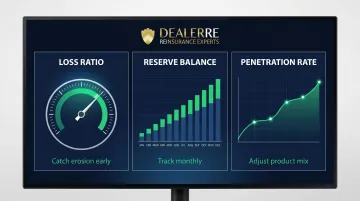
Look for a reinsurance partner that delivers regular performance reports with enough detail to identify trends early — reserve erosion, declining penetration rates, or shifting loss ratios are all easier to correct when caught at month three rather than month twelve.
How to Choose the Right Reinsurance Partner
The partner you choose shapes how the program is structured, how it performs, and how much of the administrative burden falls on the dealership. Vetting potential partners carefully before committing is essential.
Key Criteria for Evaluating a Reinsurance Partner
1. Genuine freedom and control
Confirm that you'll have full authority over premium funds, claims decisions, and product selection. Some partners impose restrictions that quietly erode the control the program is supposed to give you.
2. Transparent fees
Ask for a line-by-line breakdown of every fee before signing anything. Some administrators charge a 10% "claims" fee applied to the total value of each claim — a cost that compounds quickly at volume.
3. Powersports-specific experience
Automotive reinsurance experience doesn't automatically translate to powersports. Look for a partner with a track record in the powersports F&I space specifically, where product mix, claim patterns, and customer profiles differ.
4. Full-service administrative support
The strongest partners handle claims adjudication, compliance management, financial reporting, F&I training, and performance analysis — not just initial setup. DealerRE's full-service admin obligor model, backed by 28+ years of experience, is built on exactly this structure: the dealer keeps the profits while an experienced team manages the complexity.
Knowing what good looks like makes it easier to spot the warning signs.
Red Flags to Watch For
- Providers who won't let you manage your own premium funds or participate in high-dollar claims decisions
- Programs where terms appear to benefit the provider more than the dealership
- Partners who lack experience specifically in the powersports F&I space
- Lack of detailed reporting or drill-down capability into claims and reserves
- "Big box" carriers that offer professional presentations but lack substantive support
Frequently Asked Questions
What is a reinsurance program?
A reinsurance program is an arrangement where a dealership sets up its own company to assume a portion of the risk on F&I products it sells. This allows the dealer to capture the underwriting profits — the premiums remaining after claims are paid — rather than leaving those earnings with a third-party administrator.
How to make money in reinsurance?
Dealers make money in reinsurance by collecting premiums from F&I product sales into their own reinsurance entity, paying out claims from those reserves, and keeping the remaining underwriting profit. These funds can also be invested for additional returns over time.
What F&I products can a powersports dealer reinsure?
The most common products include vehicle service contracts, appearance protection, tire and wheel coverage, prepaid maintenance, and battery replacement programs. GAP is typically excluded due to its higher loss volatility and total-loss risk.
How much volume does a powersports dealer need to start a reinsurance program?
Volume requirements vary by program structure, but industry sources generally cite 20-30 VSC contracts per month (or 300-350 annually) as the minimum threshold for a CFC program to be financially worthwhile. Reviewing your actual F&I data with an experienced administrator gives you a clearer picture of where you stand.
What is an admin obligor reinsurance structure?
In an admin obligor structure, the dealer's reinsurance company is backed by an A-rated insurance carrier, which provides financial stability and reduces direct risk exposure while still allowing the dealer to participate in underwriting profits.
How long does it take to set up a dealer reinsurance company?
Setup timelines vary depending on program structure and partner. Working with a full-service partner who handles legal filings, compliance, and administrative setup significantly shortens the process. Core formation steps typically include:
- Domicile selection and entity formation
- Business plan development
- Treaty negotiation and tax election