

Introduction
Auto dealers who sell F&I products like vehicle service contracts (VSCs) and GAP insurance often subsidize third-party insurers' profits without realizing it. Each time a customer purchases an extended warranty or protection plan, a significant portion of that premium flows to outside companies — companies that retain the underwriting profit, control the claims process, and leave dealers with only a fraction of the value they helped create.
That profit gap is driving real interest in captive structures. According to Haig Partners, publicly traded auto retail groups reported average F&I gross profit per vehicle retailed (PVR) of $2,534 in Q3 2025, a 5.2% year-over-year increase. For independent dealers, NIADA benchmarks achievable F&I profit at approximately $1,100 per retail unit. When those numbers are flowing in part to third-party providers, the case for recapturing them becomes harder to ignore.
Setup and operating costs for an 831(b) captive vary widely depending on program structure, domicile, premium volume, and management approach. Misunderstanding these costs is one of the primary reasons dealers delay or abandon the idea altogether.
The missteps tend to follow recognizable patterns:
- Underbudgeting by accounting only for formation fees while ignoring minimum capital requirements
- Choosing the cheapest setup option without evaluating ongoing IRS compliance exposure
- Over-engineering the program with enterprise risk coverage that isn't needed — raising both cost and audit risk
What follows is a line-by-line cost breakdown, the key variables that drive those numbers, and the expenses most dealers miss entirely.
Key Takeaways
- Typical first-year costs range from $150,000 to $450,000 (formation + capital contribution)
- Annual ongoing costs run $50,000 to $120,000+ depending on program complexity
- Admin obligor structures simplify IRS filing requirements and lower ongoing compliance costs
- Full-service program partners bundle legal, actuarial, tax, and management services into a single relationship, eliminating the need to coordinate multiple vendors
- Dealers moving 100+ units monthly with an average VSC premium above $800 typically recover setup costs within 2–3 years
How Much Does It Cost to Set Up an 831(b) Captive Insurance Company?
There is no single fixed price for setting up an 831(b) captive. Costs depend on the type of program, the state of domicile, the premium volume the dealer expects to write, and who manages the program.
Dealers who misread the cost picture tend to fall into the same traps:
- Underbudgeting by accounting for formation fees only, while ignoring minimum capital requirements
- Choosing the cheapest setup without evaluating ongoing IRS compliance exposure
- Over-engineering the program with enterprise risk coverage they don't need, raising both cost and audit risk
Typical Cost Ranges
| Setup Tier | Who It Fits | Cost Range | What's Included |
|---|---|---|---|
| Entry-level | Small dealer, minimal premium volume, single-state domicile | $5,000–$25,000 (formation only) | Legal and filing costs to establish the entity — excludes capitalization, actuarial fees, and ongoing management |
| Mid-range | Active F&I program, admin obligor structure | $150,000–$300,000 (combined first-year) | Formation + capitalization + actuary; most common tier for independent and franchise dealers wanting a turnkey setup |
| Full-service | Higher premium volume, full management partner | $75,000–$150,000+ per year (recurring, post-capitalization) | Training, compliance, ongoing administration, and tax filings — dealer handles none of the compliance or administrative coordination directly |
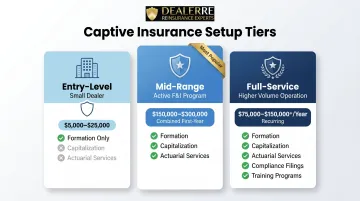
The setup fee is only one component. Minimum capital requirements — which vary by domicile — represent a separate capital commitment that is not a sunk cost. The money stays in the captive as a reserve asset, available for claims and solvency requirements.
Key Factors That Affect Your 831(b) Captive Setup Cost
Pricing an 831(b) captive is not one-size-fits-all. The following technical, operational, and regulatory factors determine where a dealer lands within the cost spectrum.
Type of Captive Program Structure
Traditional 831(b) captives — where the dealer is the insured — work differently from admin obligor reinsurance structures, where the dealer's company reinsures consumer product contracts rather than enterprise risk.
Admin obligor programs often fall outside the IRS "insured" definition under the 2025 micro-captive regulations. According to The Tax Adviser, many consumer-focused reinsurance programs qualify for the Consumer Coverage Exception and may not require Form 8886 reporting. That exception can meaningfully reduce compliance overhead — including legal and actuarial costs.
Enterprise risk coverage — such as cyber liability, employment practices liability, or business interruption inside the captive — adds complexity, cost, and IRS scrutiny risk. Dealers focused purely on reinsuring F&I products typically operate cleaner, simpler programs with lower ongoing compliance costs.
Domicile Selection
Domicile — the state or territory where the captive is licensed — significantly impacts formation fees, minimum capital requirements, and annual regulatory costs. Some states like Tennessee, Utah, and Vermont have well-established captive laws, while others are newer.
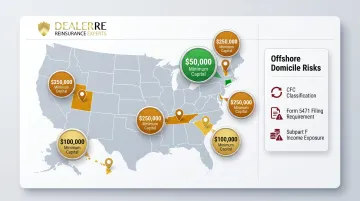
According to the NAIC Model Law Chart, pure captive minimum capital requirements vary widely:
- Connecticut: $50,000
- South Carolina and Hawaii: $100,000
- Tennessee, Utah, Delaware, Vermont: $250,000
Offshore domiciles may appear cheaper upfront but add complexity, reporting requirements, and potential IRS red flags for smaller programs. For example, a foreign-domiciled captive owned by a US person is classified as a Controlled Foreign Corporation (CFC), requiring annual Form 5471 filings and potentially triggering Subpart F income rules.
Premium Volume and F&I Product Mix
The 831(b) election allows a captive to receive up to $2.9 million in annual premiums (2026 limit, indexed for inflation) tax-free on underwriting income, according to Captive Review. The higher the F&I product volume, the more premium flows into the captive, which affects both the program's profitability and its capitalization needs.
Dealers with strong VSC, GAP, and ancillary product sales are better positioned to maximize the captive's benefit relative to its cost.
To put that in concrete terms: a dealer selling 150 units per month with 65% product penetration and an $800 average premium would generate approximately $936,000 in annual premium, according to modeling by F&I Direct.
Level of Management Support
Dealers generally choose between two approaches: a self-directed captive, where they engage attorneys, actuaries, accountants, and a captive manager separately, or a full-service program partner who coordinates all services together.
Piecemeal arrangements carry real coordination risk. Common friction points include:
- Compliance gaps when vendors operate on different timelines
- Conflicting legal or actuarial interpretations across separate firms
- Higher aggregate cost when each provider bills independently
A single program partner addresses these by keeping all compliance, filing, and actuarial work coordinated — though dealers should vet any provider's track record and fee structure carefully before committing.
IRS Compliance and Actuarial Requirements
A properly structured 831(b) captive requires annual actuarial pricing opinions to ensure premiums are arm's-length and defensible. This is not optional. The IRS has heavily scrutinized captives with inflated or unsupported premiums.
Actuarial fees typically range from $5,000 to $15,000 annually, according to Gregory & Appel.
Properly structured dealer admin obligor programs that meet the Consumer Coverage Exception may not require Form 8886 filings, reducing compliance overhead. The 2025 IRS final regulations (Treas. Reg. 1.6011-10 and 1.6011-11) provide significant relief for legitimate dealer F&I captives reinsuring consumer products.
Complete Cost Breakdown: One-Time and Ongoing Expenses
The total cost of an 831(b) captive goes beyond the initial formation fee. Dealers need to account for both one-time and recurring expenses to accurately evaluate ROI.
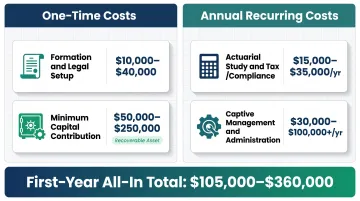
Formation and Legal Setup Fees
This one-time cost covers articles of incorporation, domicile application and licensing fees, initial legal drafting of the captive's governing documents, and regulatory filing fees.
Typical range: $10,000 to $40,000 depending on domicile type (domestic vs. offshore) and complexity.
Minimum Capital and Reserve Contribution
This is a one-time asset, not an expense. Most domiciles require the captive to be capitalized with a minimum surplus — that money stays in the captive as a reserve asset, but it does represent a liquidity commitment.
Typical minimum capital requirements range from $50,000 to $250,000 depending on domicile. For example:
- South Carolina and Hawaii allow formation at $100,000 under certain conditions
- Tennessee, Utah, Delaware, and Vermont require $250,000
Tennessee allows capital in the form of cash, marketable securities, or an irrevocable letter of credit from an approved bank.
Actuarial Study and Legal/Tax Filings
An actuarial pricing study is required at setup and updated annually. Combined with tax return preparation and state regulatory filings, this becomes a recurring cost starting in year one.
Annual combined cost for actuarial + tax/compliance services: $15,000 to $35,000.
Annual Captive Management and Administration Fees
This ongoing fee covers day-to-day operations, claims adjudication, performance reporting, F&I training, and compliance monitoring. Some dealers work with multiple vendors across these functions; others use a full-service program partner like DealerRE that consolidates them under a single management fee.
Typical annual management fee ranges: $30,000 to $100,000+ depending on program complexity and premium volume. According to Gregory & Appel, fees are typically structured as either:
- Flat annual fee: $36,000 to $100,000+
- Percentage of annual written premiums: 15% to 35%
Total Cost Summary
| Cost Category | Type | Typical Range |
|---|---|---|
| Formation & Legal Setup | One-Time | $10,000 – $40,000 |
| Minimum Capital Contribution | One-Time (Asset) | $50,000 – $250,000 |
| Actuarial Study & Tax/Compliance | Year 1 + Annual | $15,000 – $35,000/yr |
| Captive Management & Administration | Annual | $30,000 – $100,000+/yr |
First-year all-in costs typically fall between $105,000 and $360,000, depending on domicile and program scale — with the capital contribution recoverable as a captive asset.
Minimal Setup vs. Full-Service Captive Program — What's the Difference?
Not all 831(b) captive programs are built the same. Dealers can piece together a minimal, bare-bones setup or engage a full-service program partner, and the difference in cost, risk, and outcomes is significant.
Minimal/Piecemeal Setup
The upfront formation cost is lower, but the dealer carries the full coordination burden. Most dealers end up independently sourcing and managing:
- A captive attorney for formation and legal documents
- A separate actuary for premium pricing and compliance
- A domicile manager for ongoing regulatory filings
- A CPA with captive-specific tax experience
No F&I training or claims support is typically included. These arrangements often cost more overall due to fragmented billing and coordination gaps across multiple vendors.
Full-Service Program
A single program partner handles everything under one roof. DealerRE's admin obligor reinsurance model, for example, covers:
- Legal formation documents and domicile filings
- Annual tax returns and regulatory renewals
- Actuarial compliance and premium pricing support
- Claims adjudication and F&I staff training
The annual program fee may appear higher than a bare-bones setup. In practice, the bundled structure reduces hidden costs, limits IRS exposure, and lets dealers start retaining underwriting profit from day one — without chasing down four separate vendors every time a deadline arrives.
What Auto Dealers Often Overlook When Budgeting for an 831(b) Captive
Fixating on Formation Fees While Ignoring Ongoing Management Costs
Many dealers compare captive options based on setup fees alone, but the real financial picture is the total annual cost of ownership. Formation is a one-time event, while management and compliance fees recur every year. A cheaper setup with expensive or disorganized ongoing administration is rarely a bargain.
Overlooking the Capital Lock-Up
The minimum capitalization requirement is not a fee — the money stays in the captive — but it does represent real liquidity that the dealer cannot access freely. Dealers who don't plan for this may find themselves undercapitalized at a critical moment or tempted to undermine the program's integrity by withdrawing funds prematurely.
Ignoring the Revenue Side of the Equation
Too many dealers evaluate captive costs in isolation, without accounting for what the program actually returns. A properly structured 831(b) program generates three distinct profit streams:
- Retains underwriting profits previously paid to third-party warranty and insurance companies
- Earns investment income on reserves held inside the captive
- Creates meaningful tax advantages through premium deductions
The numbers bear this out. According to F&I Direct, a mid-size dealership selling 150 units per month with 65% product penetration and an $800 average VSC premium can generate $936,000 in annual premium. At a 35% blended loss ratio, the dealer retains approximately $608,400 annually — accumulating over $3 million in five years with investment returns.
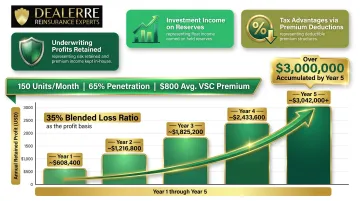
That return makes every line item in the cost breakdown worth running against the profit potential, not just the setup invoice.
Frequently Asked Questions
How much does it cost to set up a captive insurance company?
Total first-year costs typically range from $150,000 to $450,000, including formation fees ($10,000 to $40,000), minimum capital contribution ($50,000 to $250,000), and first-year management and actuarial services ($30,000 to $120,000). Costs vary by domicile, program complexity, and service provider.
How much does a captive management fee cost?
Annual management fees range from $30,000 to $100,000+, with full-service programs bundling administration, compliance, filings, and reporting into a single fee. Some providers charge a percentage of premiums (15% to 35%) rather than a flat annual rate.
Is captive insurance worth it?
Dealers can recapture underwriting profits, gain tax advantages on premium income, and build reserve assets over time. Higher-volume dealers (100+ units/month, $800+ average VSC premium) typically see the clearest payback within 2 to 3 years.
What is the 831(b) limit?
The 831(b) premium limit is $2.9 million annually (2026), indexed for inflation since the 2015 PATH Act. Captives electing under 831(b) pay no federal income tax on underwriting profit — only on investment income (interest, dividends, capital gains).
What is the minimum capital requirement for captive insurance?
Minimum capital requirements vary by domicile, ranging from $50,000 (Connecticut) to $250,000 (Tennessee, Utah, Delaware, Vermont). This capital stays in the captive as a reserve asset, available to pay claims and maintain regulatory solvency.
Can auto dealers use an 831(b) captive for F&I products like VSCs and GAP insurance?
Yes. Dealer reinsurance companies are commonly structured as admin obligor programs that reinsure VSC, GAP, and other consumer F&I products. Under the 2025 IRS micro-captive regulations, many of these programs qualify for the Consumer Coverage Exception and may not require Form 8886 reporting, reducing compliance burden.