
Introduction
Many auto dealers with F&I reinsurance programs assume the IRS regulations finalized in January 2025 are bad news across the board for captive insurance arrangements. For most dealers running standard F&I reinsurance programs, the opposite is true — and many haven't heard that yet.
Yes, the IRS finalized major rules targeting abusive micro-captive tax shelters. For the vast majority of dealers with F&I reinsurance programs, however, these regulations provide clear safe harbor protections that exempt their programs from IRS reportable transaction disclosures. The problem is that many dealers are getting conflicting guidance from advisors who aren't familiar with how F&I reinsurance structures actually work.
This article breaks down the IRS rules specific to dealer-owned captive reinsurance companies, covering:
- What the January 2025 regulations actually say
- Which dealers are affected — and which are protected
- What compliance steps to take to avoid unnecessary IRS scrutiny
Key Takeaways
- The IRS finalized micro-captive regulations (1.6011-10 and 1.6011-11) effective January 14, 2025, targeting abusive micro-captive tax shelters — not standard dealer F&I reinsurance structures
- Most auto dealer F&I reinsurance programs qualify for the "Seller's Captive Exception" and are not required to file Form 8886 — provided the program covers 95%+ customer risk, not dealership enterprise risk
- Dealers still filing Form 8886 under obsolete Notice 2016-66 may be inviting unnecessary IRS scrutiny — continued filing is worth reviewing with qualified counsel
What Is a Dealer-Owned Captive Insurance Company?
A dealer-owned captive insurance company is a reinsurance entity owned by the dealer that exists to reinsure risks associated with F&I products sold to customers. These products include vehicle service contracts (extended warranties), GAP coverage, collateral protection insurance, and ancillary products like tire and wheel protection.
The Section 831(b) Election
Under IRS Code Section 831(b), small insurance companies that receive premiums under a specified annual limit can elect to be taxed only on investment income, excluding underwriting profits from corporate income tax. For 2026, this premium limit is $2,900,000.
This favorable tax treatment is why the IRS has scrutinized certain micro-captive arrangements. The tax benefit is legitimate when the captive operates as genuine insurance — not a disguised tax shelter.
Traditional Captive (831(a)) vs. Micro-Captive (831(b))
Section 831(a) represents the default tax treatment: both underwriting income and investment income are taxed. Section 831(b) offers the election to exclude underwriting profits from taxation, with tax imposed only on investment income.
The IRS's concern is specifically with 831(b) captives used as tax shelters — not legitimately structured dealer reinsurance programs that pass real risk from customers to the captive.
How Dealer Reinsurance Works
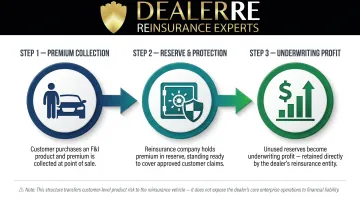
In DealerRE's admin obligor reinsurance model, premium flows to the dealer's own reinsurance company rather than to a third-party provider. The process follows three steps:
- Customer purchases an F&I product and pays the premium
- Reinsurance company holds the premium in reserve to cover potential claims
- Unused premium after claims and expenses becomes underwriting profit retained by the dealer
This structure is structurally different from abusive captive arrangements because the risk being insured is customer risk, not the dealership's own enterprise risk. Under the 2025 regulations, this distinction — insuring customer-facing risk versus manufacturing internal tax benefits — is what separates compliant dealer reinsurance from IRS-targeted shelters.
The 2025 IRS Final Regulations: What Auto Dealers Need to Know
For most dealer reinsurance structures, the 2025 IRS final regulations are not the threat they appear to be — but only if you understand exactly where the rules apply. The IRS has pursued abusive micro-captive tax shelters since 2011, and after years of legal challenges — including the CIC Services Supreme Court case — it issued finalized regulations in January 2025 that replace the old Notice 2016-66 with clearer, more targeted rules.
Understanding the three key definitions in these regulations determines whether your program is covered at all.
Reportable Transactions: Listed vs. Transactions of Interest
The regulations categorize certain micro-captive arrangements as either:
- Listed transactions — presumed abusive, most serious category
- Transactions of interest — potentially abusive, requires disclosure
Both categories require Form 8886 disclosure, but the stakes differ. Listed transactions carry automatic penalties for failure to disclose; transactions of interest trigger scrutiny and reporting obligations but do not carry the same automatic penalty exposure.
Three Key Definitions That Determine Coverage
1. Definition of "Insured"
A party is an "Insured" only if it conducts a trade or business, enters into the contract, and treats premiums as insurance for federal tax purposes.
Critical insight: Most dealer reinsurance companies insuring customer risk are not the "insured" party. The preamble to the regulations explicitly states: "A Seller is not an Insured if it facilitates an Unrelated Customer entering into a contract with Seller's Captive."
This means most administrator obligor structures fall entirely outside the regulations and require no Form 8886 filing.
2. Definition of "Captive"
An entity is a "Captive" only if it meets all three conditions:
- Makes an 831(b) election
- Issues or reinsures a contract to an Insured
- Has at least 20% common ownership between the captive and the Insured
3. The Consumer Coverage Exception (Seller's Captive Exception)
This exception carves out legitimate seller's captives and is the primary safe harbor for dealers operating administrator obligor reinsurance programs. Under this provision, a captive that reinsures contracts sold to unrelated retail customers — rather than insuring the dealer's own business risk — falls outside the regulated micro-captive definition entirely. For most dealers working with an administrator obligor structure, this exception confirms the program is not a reportable transaction under the 2025 rules.
Important Legal Development
A federal district court in Ryan LLC v. IRS ruled that the IRS's 30% and 60% loss-ratio thresholds used to classify micro-captive arrangements are arbitrary and capricious under the Administrative Procedure Act. This ruling directly affects how the IRS can apply its listed transaction and transaction-of-interest classifications going forward. Dealers and their tax advisors should review whether any existing program disclosures were triggered by those thresholds — and whether amended filings may be appropriate.
The Seller's Captive Exception: The Good News for Most Dealer F&I Reinsurance Programs
Even for dealer reinsurance companies that technically meet the definition of a "captive," the final regulations carve out an explicit safe harbor that exempts them from classification as a listed transaction or transaction of interest — and from any Form 8886 filing obligation.
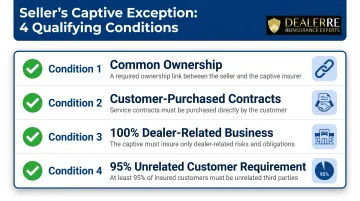
Four Conditions to Qualify for the Exception
1. Common Ownership The reinsurance company must be owned by the same individuals (or related individuals) who own the dealership.
2. Customer-Purchased Contracts The reinsurance company issues or reinsures contracts purchased by unrelated customers in connection with products or services sold by the dealership.
3. 100% Dealer-Related Business 100% of the reinsurance company's business involves issuing or reinsuring contracts connected to the dealership's products or services.
4. 95% Unrelated Customer Requirement At least 95% of the reinsurance company's business for the tax year involves contracts purchased by customers who are unrelated to the dealership or reinsurance company owners — with the remaining 5% accounting for occasional sales to related parties such as family members.
What Disqualifies a Dealer Captive
The presence of enterprise risk disqualifies a dealer captive from this exception. If the captive insures any underlying risks of the dealership business itself rather than exclusively insuring consumer-facing product risks, it falls outside the safe harbor. Disqualifying coverage types include:
- Property damage to the dealership lot
- Employee-related risks
- Business interruption coverage
Critical Implication for Protective Filers
For dealers who have been filing Form 8886 protectively since 2016 under Notice 2016-66, continuing to file under that now-obsolete notice may do more harm than good. Filing when no obligation exists can draw unnecessary IRS scrutiny. Dealers should consult with qualified advisors to confirm whether continued filing is required.
Most F&I reinsurance programs — including dealer admin obligor structures where premiums flow from unrelated customer service contracts back to the dealer's reinsurance company — are designed precisely around the consumer-risk model the Seller's Captive Exception protects.
That alignment matters. Dealers who maintain clean program structure stay well outside the IRS's listed transaction rules, preserving the tax planning and profit retention benefits these programs are built to deliver.
Listed Transactions vs. Transactions of Interest: Criteria the IRS Is Actually Targeting
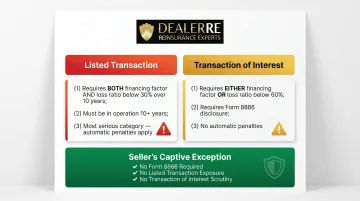
Listed Transaction
A captive is classified as a listed transaction (the most serious category, presumed tax avoidance) if it meets BOTH:
- Financing Factor: The captive made available financing or otherwise conveyed to a recipient (owner, insured, or related person), in a transaction that did not result in taxable income, any portion of amounts received under a contract (e.g., guarantees, loans, capital transfers)
- Loss Ratio Factor: The captive's loss ratio is below 30% over the most recent 10 taxable years
The micro-captive must have been in operation for at least 10 years to be classified as a listed transaction.
Transaction of Interest
A captive is classified as a transaction of interest (less severe but still requiring Form 8886 disclosure) if it meets EITHER:
- The financing factor described above, OR
- A loss ratio below 60% over the applicable period
The loss-ratio thresholds are currently being challenged in court as arbitrary.
Seller's Captive Exception: Exempt from Both Categories
Those thresholds only matter if your program falls within the IRS's scope in the first place. For dealers whose reinsurance programs qualify for the Seller's Captive Exception, neither category applies — regardless of loss ratios or program history:
- No Form 8886 disclosure required
- No listed transaction exposure
- No transaction of interest scrutiny
What Dealers Should Do Now: Compliance Steps and Next Steps
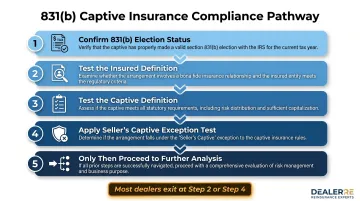
Work through this compliance checklist:
1. Confirm 831(b) Election Status Check whether an 831(b) election is currently in place for your reinsurance entity.
2. Test the "Insured" Definition For most admin obligor F&I reinsurance programs, no insured exists under the regulatory definition, meaning the regulations simply do not apply.
3. Test the "Captive" Definition If an insured does exist, determine whether the arrangement meets the three-part Captive definition (831(b) election, contract with insured, 20%+ common ownership).
4. Apply the Seller's Captive Exception Test If it qualifies as a Captive, test whether your arrangement meets all four conditions of the Seller's Captive Exception.
5. Only Then Proceed to Further Analysis Only if the exception is not met does further listed transaction or transaction of interest analysis apply.
Critical Action for Protective Filers
Dealers who have been filing Form 8886 under Notice 2016-66 should have their specific program reviewed immediately. Continued protective filing under an obsolete notice is likely an error under the final regulations — and could draw IRS attention rather than deflect it.
The Role of Specialized Administration
Compliance questions, annual filings, legal forms, and program structure updates require consistent, informed oversight. DealerRE's full-service administration handles all of it on behalf of dealer clients, including:
- Legal forms, filings, and renewals
- Tax returns and bookkeeping
- Program structure reviews as regulations evolve
- Coordination with CPAs and legal counsel
That means dealers aren't navigating IRS rule changes alone. DealerRE has managed these programs since 1994 — through multiple regulatory shifts — and keeps clients on the right side of compliance without disrupting profitability.
Frequently Asked Questions
What is the IRS code for captive insurance?
Section 831(b) of the Internal Revenue Code governs micro-captive insurance companies. It allows qualifying small insurance companies to elect to be taxed only on investment income rather than underwriting profits, subject to annual premium limits ($2,900,000 for 2026) and other requirements.
How does a captive insurance policy work?
In a dealer captive arrangement, the dealership sells F&I products (like vehicle service contracts) to customers. The premiums are ceded to the dealer-owned reinsurance company, which assumes the risk of claims. Over time, well-managed programs return underwriting profits back to the dealer instead of surrendering them to outside providers.
What is a micro-captive transaction?
A micro-captive transaction involves a small insurance company that has made a Section 831(b) election. The IRS uses the term specifically to describe captive arrangements it monitors for potentially abusive tax avoidance, including those with low loss ratios, related-party financing, and insufficient risk distribution.
Is captive insurance a reportable transaction?
Not all captive insurance arrangements are reportable transactions. Under the 2025 final regulations, a dealer reinsurance company that qualifies for the Seller's Captive Exception is explicitly excluded from reportable transaction status and does not need to file Form 8886.
How are captives taxed?
Tax treatment depends on which election the captive makes:
- 831(b) election: The captive pays tax only on investment income; underwriting profits are excluded from income tax.
- 831(a) election: The captive is taxed on both underwriting profits and investment income.
Dealers also receive an ordinary income tax deduction for premiums paid to the captive.
What is the 831(b) limitation for 2026?
The IRS-published annual net written premium limit for the 831(b) election applicable to the 2026 tax year is $2,900,000. This figure is adjusted each year for inflation.