Introduction
F&I departments consistently deliver the highest gross profit margins in dealership operations — publicly owned dealerships reached $2,612 per vehicle in Q4 2024, an all-time record. But these numbers only appear when dealers build menus around the right products.
Poor product selection erodes both profitability and customer trust. Without clear selection criteria, F&I menus produce low acceptance rates, weak service retention, and profit that flows to third-party providers instead of your dealership.
This guide covers what F&I products are, which categories belong on most dealership menus, the key factors driving smart product selection, and how to match your product mix to your specific dealership type.
Key Takeaways
- F&I products are optional protection plans offered once the vehicle sale closes
- Smart menus match your inventory, customer base, and dealership type — not a generic product list
- Evaluating administrator quality, price point, profit structure, and compliance helps you select products worth offering
- Franchise, independent, and BHPH dealers need different product mixes
- Dealer-owned reinsurance captures long-term profit that third-party providers otherwise keep
What Are F&I Products and the F&I Menu?
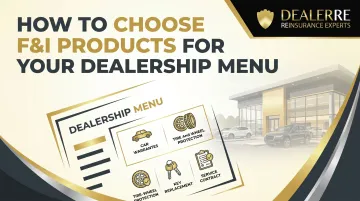
F&I products are optional protection plans, coverage agreements, and finance office products presented by a dealership's finance and insurance department at the point of vehicle purchase. These products are sold separately from the vehicle price itself and include:
- Vehicle service contracts
- GAP coverage
- Tire and wheel protection
- Appearance protection
- Key replacement
The F&I menu is a structured presentation tool — physical or digital — that organizes available products into tiered packages. This allows the F&I manager to present coverage options consistently to every buyer. Menu selling increased overall penetration by 12% in 2023 pilots, proving that how you present products matters as much as which products you offer.
Why the Products You Put on That Menu Matter
Product selection directly impacts three metrics that define F&I performance:
- Per-vehicle retail (PVR) — the gross profit generated per deal
- Product acceptance rate — how often buyers add at least one product
- Service retention — whether customers return to your service lane
Choosing products customers don't value drags down all three.
The menu also shapes dealer profitability beyond the deal itself. Depending on how products are structured — third-party versus dealer participation — the same sale can mean very different long-term income for your store.
F&I contributed 58% of total dealership gross profit in Q4 2024. That makes product selection the highest-impact profitability decision a dealer controls.
Core F&I Products to Consider for Your Dealership Menu
While dozens of F&I products exist, most high-performing dealership menus are built around a core set of anchor products backed by ancillary options. The goal is relevance and trust, not volume.
Anchor Products
Vehicle Service Contracts (VSCs) / Extended Warranties
VSCs are consistently the highest-volume F&I product across both new and used sales. They cover mechanical repair costs beyond the manufacturer's warranty and are the most universally understood value proposition for buyers.
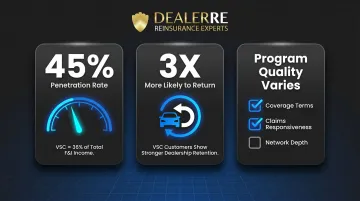
Three data points every dealer should know:
- VSC penetration sits at approximately 45%, representing 36% of total F&I income — the largest single product category
- Customers with a VSC are nearly 3X more likely to return for service, making them a service retention tool as much as a profit driver
- Program quality varies significantly between administrators — coverage terms, deductibles, and claims responsiveness determine whether buyers see value or feel burned
GAP Insurance
GAP covers the difference between what a customer owes on their loan and the vehicle's actual cash value in a total loss or theft scenario. It's a strong product for buyers with low down payments or long loan terms.
GAP penetration reached 38% in Q2 2025. The CFPB found that 11.7% of auto loan originations carry negative equity, with average loan-to-value reaching 119.3% on those deals. This structural exposure makes GAP essential for financed vehicles.
Dealers should evaluate GAP carefully in their reinsurance structure since fluctuating used car values can create exposure. State-specific regulations also require close attention.
Ancillary Products
Tire and Wheel Protection / Appearance Protection
Tire and wheel coverage resonates strongly with used car buyers in markets with rough roads or harsh winters. Appearance protection (interior and exterior) adds visible, tangible value and is easy to present.
Paint-and-fabric protection reached 20% penetration, while tire-and-wheel plans hit 11%. Both bring customers back to the service drive for claims — a retention benefit that compounds over time. At 50–65% profit margins, tire-and-wheel ranks among the highest-margin ancillary products on any menu.
Key Replacement, Anti-Theft, and Lifetime Engine Warranties
Each of these products addresses a specific buyer concern while adding incremental PVR with minimal payment resistance. Key replacement is high-value for modern vehicles — key fobs typically run $300–$500 retail, and the product carries 60–70% margins.
Lifetime engine warranties drive service retention because they typically require buyers to return to the dealer for scheduled maintenance. These products are easy to present and add incremental PVR without significant customer payment resistance.
Key Factors to Consider When Choosing F&I Products for Your Menu
Product selection should start with honest evaluation — not what's most popular nationally, but what fits your inventory, customers, and profit goals.
Inventory Age and Price Point Alignment
The products on your menu must make financial sense for the vehicles you sell.
High-line and luxury inventory supports comprehensive VSCs and premium tire/wheel coverage because repair costs are higher. Older or lower-priced inventory is better matched with limited warranties, appearance protection, and key replacement.
Offering a $3,000 VSC on a $7,000 vehicle destroys customer confidence and acceptance rates. Coverage must feel proportionate and credible to the vehicle's value and expected repair costs.
Administrator Quality and Claims Handling
The administrator behind each product determines whether a claim is paid quickly and fairly. Every claims experience shapes customer satisfaction and word-of-mouth for the dealership, not just the product provider.
Digital claims tools reduce service bay time, increase total appointment volume, and link directly to higher Customer Service Index (CSI) scores. Real-time claim tracking reduces status-update calls, and digital imaging of damaged parts reduces disputes.
Those capabilities matter — but only if the administrator delivers on them consistently. Poor claims handling damages dealership reputation and customer loyalty. Evaluate administrators on claims turnaround time, digital processing capabilities, and dispute resolution rates — not solely on commission structure.
Profit Participation and Reinsurance Structure
How a product is structured financially — whether the dealer retains underwriting profit or passes it to a third party — is just as important as what the product covers.
Dealers who select products backed by a dealer-owned reinsurance program can capture 100% of the underwriting profit that would otherwise go to the provider. This is where DealerRE's admin obligor reinsurance programs provide a distinct advantage: by helping dealers establish their own reinsurance company, DealerRE ensures the F&I products a dealer sells become a long-term wealth-building asset, not just a per-deal revenue line.
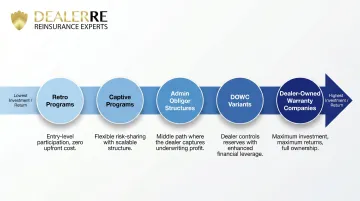
Five reinsurance structures exist across a spectrum of investment and return:
- Retro programs — entry-level, no upfront investment, lower returns
- Dealer-owned warranty companies — highest investment, highest returns
- Admin obligor structures — middle path where the administrator assumes contractual liability while the dealer captures underwriting profit
- DOWC variants — dealer controls reserves and investment earnings directly
- Captive programs — structured risk-sharing with more flexibility than traditional retro
Compliance and Regulatory Fit
F&I product selection must account for state-specific regulations. Some products — particularly GAP and credit insurance — are more tightly regulated in certain states, and choosing non-compliant products creates legal exposure.
The FTC's CARS Rule was vacated in January 2025, but California, Massachusetts, and Illinois have enacted or strengthened state-level F&I disclosure mandates. California's SB 766 adds a 10-day right of cancellation for used vehicles. Massachusetts now requires total-price disclosure including all fees and mandatory ancillary products.
Dealers whose menus are structured correctly and disclosed transparently earn more customer trust — and face fewer regulatory complaints. Getting compliance right protects the deal and the relationship.
Staff Training and Presentation Capability
A product your F&I manager cannot explain clearly will not sell — full stop. Factor in whether your team is already equipped to present each product and handle objections before adding it to the menu.
Not every product demands the same training lift:
- High-complexity products (reinsurance-backed VSCs, multi-tier bundles) require dedicated training investment before launch
- Lower-complexity products (key replacement, tire/wheel coverage) can be integrated quickly with minimal onboarding
Default-inclusion language ("included unless waived") doubles F&I product penetration versus traditional add-on pitches. This means presentation training can deliver immediate PVR gains without changing products.
Matching Your F&I Product Mix to Your Dealership Type
One of the most common F&I mistakes is treating the menu as one-size-fits-all. The optimal product lineup differs meaningfully across dealership types.
Franchise Dealerships
Franchise dealers typically carry newer inventory with manufacturer warranties still in effect. The VSC pitch is about extending coverage, not replacing it.
Comprehensive service contracts, tire/wheel protection, and appearance protection tend to perform best. GAP is a strong add for buyers with minimal down payments. Franchise dealer F&I PVR reached $2,612 in Q4 2025, reflecting the higher product mix these stores support.
Independent and Used Car Dealerships
Independent dealers selling older or higher-mileage inventory should anchor their menus on products that deliver visible, immediate value:
Independent dealers selling older or higher-mileage inventory should anchor their menus on products that deliver visible, immediate value:
- Limited warranties and VSCs — matched carefully to vehicle age and condition to manage claim exposure
- Appearance protection for immediate, tangible customer value
- Key replacement as a low-cost, high-perceived-value add
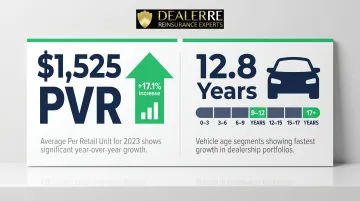
Independent dealer F&I gross reached $1,525 per vehicle in 2025, a 17.1% increase. That growth tracks with a broader market shift: the average vehicle age on U.S. roads has reached 12.8 years, with the fastest-growing segments at 9–12 years and 17+. Older vehicles mean more customers who need — and will pay for — mechanical protection.
BHPH Dealerships
BHPH dealers operate under a different set of constraints. Buyers have limited credit and tighter budgets, so every product on the menu needs to be affordable, clearly valuable, and directly tied to protecting the vehicle on an in-house note.
The strongest fits for BHPH menus include:
- Mechanical breakdown protection — keeps customers mobile and payments current
- Appearance coverage — tangible, low-cost protection buyers can see and appreciate
- Debt Cancellation Coverage (DCC) — covers the total debt owed after a total loss, letting the dealer place the customer in another vehicle and resume payments
Admin obligor reinsurance programs are especially well-suited to BHPH operations. Rather than paying third-party providers, dealers use customer-funded reinsurance pools to cover repair costs — keeping cars on the road, customers paying, and underwriting profits inside the dealership.
How DealerRE Can Help You Build a Profitable F&I Product Program
Building the right F&I product menu is only half the equation. The structure behind those products — who holds the underwriting risk and who keeps the profit — determines whether F&I becomes a sustainable income stream or just a transaction fee.
DealerRE helps dealers establish and manage their own admin obligor reinsurance companies, replacing third-party F&I product providers and allowing dealers to capture 100% of the underwriting profits from the products they already sell. With nearly 30 years of experience and 400+ dealers served nationwide, DealerRE handles full-service administration so dealers can focus on selling.
Key advantages include:
- F&I menu development with online and in-person training
- Full legal and compliance management, including state filings and renewals
- Performance reporting, analysis, and ongoing onboarding support
- Fast reinsurance company setup backed by an A-rated insurer
- Proven results across franchise, independent, and BHPH segments
DealerRE's admin obligor structure means the administrator assumes contractual liability while the dealer participates in profit through their own reinsurance company. Dealers take on moderate risk and investment while retaining the underwriting profit they would otherwise send to a third-party provider — without assuming full underwriting exposure.
Frequently Asked Questions
What is an example of an F&I product?
A vehicle service contract (extended warranty) is the most common example. It covers mechanical repair costs beyond the manufacturer's warranty and is one of the most widely offered products across both new and used car dealerships.
What are the primary reasons customers don't buy F&I products?
The most common objections are perceived cost, distrust of the process, not understanding the value, or feeling pressured. A well-structured menu with clearly trained F&I staff reduces each of these barriers.
What credit score is needed for F&I?
F&I products themselves (VSCs, GAP, etc.) are not credit-dependent. However, the financing used to roll those products into the loan may be affected by the buyer's credit score and the lender's terms.
How many F&I products should be on a dealership menu?
Most effective menus present 4-6 products organized into tiered packages. This gives buyers meaningful choice without overwhelming them or diluting the presentation.
Should F&I product menus differ between new and used car sales?
Yes. The menu should be adjusted based on vehicle age, price point, and warranty status. What resonates for a new car buyer (extended coverage, tire/wheel) differs from what resonates for a used car buyer (limited warranty, appearance protection, key replacement).
How does dealer-owned reinsurance relate to F&I product selection?
With dealer-owned reinsurance, the dealer captures underwriting profits that would otherwise go to a third-party provider. That changes how products are evaluated — what you offer directly affects how much income your reinsurance company retains.