Introduction
Warranty reimbursements represent one of the largest receivables on a dealer's books—yet compliance failures steadily erode that revenue through rejected claims, chargebacks, and franchise penalties. In 2024, OEM warranty revenue surged 19.9% to $28 billion as vehicle complexity and early-life repair costs climbed. That number signals real opportunity. For many dealers, though, it also represents a minefield of documentation traps and compliance failures that turn expected revenue into six-figure chargebacks.
Dealers face a core tension: OEM compliance requirements are often stricter than state law, yet many don't realize they have statutory rights that can supersede factory demands. You may be leaving hundreds of thousands of dollars on the table by defaulting to OEM procedures when your state allows retail-rate reimbursement claims.
The risks on the other side are just as real. Non-OEM parts can void coverage and trigger franchise violations, and a single failed audit can result in mass chargebacks on previously paid claims.
This guide covers:
- What OEM warranty compliance actually means
- Key documentation and procedural requirements
- Your reimbursement rights under state law
- The risks of using non-OEM parts
- How to build a compliance-ready process that protects revenue and franchise standing
TLDR
- OEM warranty compliance requires technician certification, strict documentation standards, franchise agreement adherence, and timely claim registration
- Most states give dealers the legal right to claim retail labor rates and parts markups—these statutory rights supersede OEM requests
- Using non-OEM parts risks voiding manufacturer coverage and triggering franchise violations or liability exposure
- Standardized workflows and audit-ready records protect dealers during OEM audits and accelerate claim approvals
- Dealer-owned reinsurance programs offer an alternative path to capture F&I profitability beyond OEM constraints
What Is OEM Warranty Compliance?
OEM warranty compliance is the complete set of requirements a dealership must meet to qualify for warranty reimbursements and remain in good standing under its franchise agreement. This includes documentation protocols, technician qualifications, genuine parts usage, and claims submission procedures that follow both manufacturer policies and state statutes.
Warranty management (operationally tracking claims) and warranty compliance (adhering to OEM and legal standards) are not the same thing. A dealership can manage claims actively and still fail compliance if the underlying processes don't meet OEM or statutory requirements — a distinction with direct financial consequences.
Non-compliance creates financial exposure across multiple areas:
- Claim chargebacks arrive months after initial payment, creating unexpected revenue gaps
- First-submission failure rates run as high as 30% — typically due to missing documentation, not faulty repairs
- Franchise renewal risk increases when compliance records are weak
- CSI scores suffer when warranty processes create customer friction
That makes compliance a strategic operational priority with measurable impact on dealership profitability.
Key OEM Warranty Compliance Requirements for Dealerships
Technician Certification and Training
OEMs require technicians performing warranty repairs to hold current brand-specific certifications. What does that typically include?
- Brand-specific training modules covering vehicle systems, diagnostic procedures, and repair protocols
- Annual recertification requirements to stay current on new technologies and procedures
- Strict adherence to OEM repair procedures documented in service bulletins and technical manuals
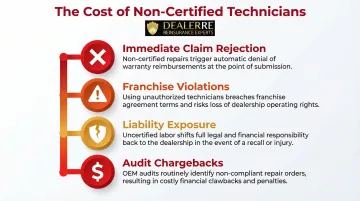
Using non-certified technicians is a leading cause of claim denials. The consequences are severe:
- Immediate claim rejections — Toyota explicitly states that claims for repairs performed by non-qualified technicians are subject to debit
- Franchise violations — Unauthorized repairs can trigger contract violations
- Liability exposure — If a non-certified tech causes additional damage, your dealer is on the hook
- Audit chargebacks — OEMs can claw back months of previously paid claims if they discover certification gaps during audits
Ford enforced its Service Technician Specialty Training (STST) Competency 10 certification requirement starting April 1, 2024, automatically rejecting Field Service Action repairs performed by non-certified technicians. GM's Technician Excellence Program requires 100% completion of Fundamentals and Emerging Issues training quarterly.
Documentation and Repair Order Standards
Incomplete documentation is one of the most common and costly compliance failures. OEMs require specific elements in every warranty repair order — and each one is a potential denial point if missed:
- Thorough technician diagnostic notes explaining the failure mode
- Scan data, photos, and test results supporting the diagnosis
- Proper labor operation codes matching the repair performed
- 3C Format (Customer Complaint, Cause, Correction) — vague entries like "engine stalls" or "replaced engine" trigger automatic chargebacks
Documentation quality at the technician level directly determines whether a claim is approved or denied. Missing "3C" entries remain a leading trigger for OEM claim denials and audit chargebacks.
GM requires individual on/off punch times on technician time tickets — punching physical job cards is non-compliant and grounds for denial. Standardizing RO templates across all service writers and technicians eliminates this exposure before an auditor finds it first.
Franchise Agreement Obligations
Franchise agreements contain binding clauses governing warranty procedures, including:
- Required use of genuine OEM parts for all warranty repairs
- Prohibited vehicle modifications that impair safety, emissions, or structural integrity
- Compliance with OEM service manuals and bulletins issued periodically
- Documentation retention requirements (typically two years minimum)
- OEM audit rights to access, examine, and verify records
Violations can trigger surcharges, warranty claim denial, or franchise termination. In Mall Chevrolet Inc v. General Motors LLC (2024), a federal appeals court upheld GM's termination of a New Jersey dealership after an audit uncovered $672,000 in fraudulent claims, including repairs for "ghost vehicles" never actually serviced.
Dealers should audit their franchise agreement language at least annually. Requirements vary significantly by OEM, and a clause you overlooked two model years ago may now be actively enforced.
OEM Warranty Reimbursement: Your Rights and Roadblocks
Understanding Your State Statutory Rights
49 states have warranty reimbursement statutes that entitle dealers to compensation at retail labor rates and parts markups for warranty work. These statutory rights supersede OEM factory requests.
Why does this matter? Because dealers often underutilize these protections by defaulting to OEM-imposed procedures without checking state law. Statutory submissions and state-mandated reimbursement rates always take precedence over what an OEM requests.
In May 2024, a federal judge dismissed Volkswagen's lawsuit challenging Illinois' 1.5x labor time multiplier. The court ruled the law was rationally related to ensuring fair compensation for dealers and technicians — reinforcing that state law governs reimbursement, not manufacturer preference.
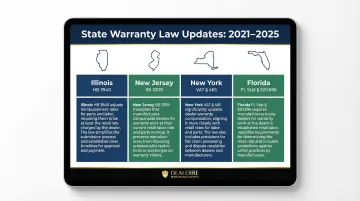
Recent State Law Updates (2021-2025):
- Illinois (HB 3940) — Mandates 1.5x multiplier on OEM time guides if no agreement exists; prohibits cost recovery surcharges
- New Jersey (SB 3309) — Establishes "Dealer-Average Multiplier Method" for labor time and tightens chargeback procedures
- New York (VAT § 465) — Allows dealers to claim reimbursement using independent retail labor-time guides instead of OEM guides
- Florida (FL Stat § 320.696) — Explicitly excludes tires, batteries, and routine maintenance from parts markup calculations
OEM Tactics That Create Compliance Friction
OEMs use several tactics to complicate reimbursement submissions:
- Demand far more documentation than state statutes require, stalling the process
- Auto-approve low rates while burying higher submissions in multi-page objections
- Route requests through third-party data centers that ask for information your state law doesn't mandate
- Stretch repayment timelines by exploiting ambiguous statutory language
When an OEM flags numerous repair orders as non-compliant, verify whether those objections actually reflect your state's statutory requirements before conceding anything. In many cases, they don't — they're negotiating pressure, not legal obligations.
Avoiding Common Submission Pitfalls
Common claim submission errors cost dealers thousands in lost reimbursements:
- Submitting without aligning to your state's specific statutory language — requirements vary significantly by state
- Including low-markup parts like tires, which pulls down your average reimbursement rate
- Missing signatures, punch times, or scan data on repair orders
- Misreading ambiguous statute language, resulting in chronic under-submissions
Florida's statute explicitly allows dealers to exclude tires, batteries, and routine maintenance fluids from markup computations to protect their true retail rate. Not excluding these items can cost you tens of thousands annually.
A warranty reimbursement consultant who knows your state's statute can prepare compliant submissions and counter improper OEM denials — often recovering reimbursement dealers didn't know they were leaving on the table.
Non-OEM Parts and Warranty Compliance
Here's the core rule: OEM manufacturers warrant genuine parts, but non-OEM parts are not covered under the manufacturer's warranty. Using non-OEM parts in repairs, even while the manufacturer's warranty remains active, can void coverage on affected components and expose your dealership to liability if problems arise.
The Magnuson-Moss Warranty Act's Role
The Magnuson-Moss Warranty Act (15 U.S.C. § 2302) generally prohibits manufacturers from voiding an entire warranty just because an aftermarket part was used. However, there are exceptions when the non-OEM part causes the defect.
This creates a specific compliance risk: manufacturers cannot blanket-void warranties for aftermarket parts, but they can deny coverage for specific components if they prove the non-OEM part caused the failure.
Enforcement is real. In 2022, the FTC issued orders against Harley-Davidson and Weber for illegally restricting customers' right to repair, prohibiting them from telling consumers their warranties would be voided by third-party parts.
Franchise Agreement Implications
Most franchise agreements include clauses that prohibit repairs using non-OEM parts when they impair vehicle safety, emissions, or structural integrity. Ford's official position statement notes it does not approve aftermarket parts and that damage caused by alternative parts is not covered by the new vehicle warranty.
State disclosure laws add another layer of obligation. Utah 31A-22-319, for example, requires repair facilities to give consumers written notice before installing non-OEM aftermarket parts — and similar statutes exist in multiple states.
Non-compliance carries consequences at several levels:
- Franchise violations — OEM agreements can be terminated or restricted
- Claim denials — manufacturers can reject warranty reimbursements tied to non-OEM repairs
- Customer liability — dealerships may bear direct financial responsibility for resulting damage
Building a Warranty Compliance Process at Your Dealership
Set Up a Standardized Warranty Workflow
Create a dedicated intake process for warranty-eligible repairs that includes:
- Standardized RO templates with mandatory fields (customer complaint, cause, correction, scan data, photos)
- Defined handoffs between service advisors, technicians, and warranty administrators
- Daily claim audit routine to catch errors before submission
- Technician certification verification before dispatching warranty work
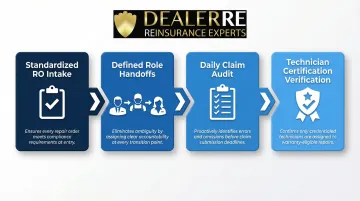
Skipping any one of these steps is where most chargebacks and denials actually originate.
Audit-Ready Documentation
Audit-ready means all repair orders, scan data, photos, service history, and OEM pre-authorization records are stored in a centralized, accessible system — your DMS or a dedicated warranty management platform. Dealerships are frequently audited months after a claim is paid, and disorganized documentation is the fastest path to a chargeback.
Modern platforms like Tekion ARC help dealerships digitize the entire audit response process, reducing document gathering time from two weeks to a single day.
Ongoing Staff Training
Every role in the service department touches warranty compliance at some point:
- Technicians — Current on OEM certifications, familiar with documentation standards
- Service advisors — Know mandatory RO fields and customer communication requirements
- Warranty administrators — Understand both OEM procedures and state statutory rights
OEM requirements shift frequently — training needs to follow the same cadence, not just happen once at onboarding. That consistency also matters when claims are being tracked post-submission.
Track Every Claim from Submission to Payment
Unresolved or stalled claims are a silent revenue drain. Whether you're using DMS tools or a manual log, the system needs to flag pending claims, track OEM response timelines, and escalate issues before statutory deadlines pass. Florida limits warranty audits to 12 months, while Washington limits them to one year unless false claims are disclosed. Know your state's statute and enforce your rights.
Beyond OEM Warranties: Building a More Profitable F&I Strategy
While OEM warranty compliance protects baseline revenue, it doesn't give dealers full control over profitability. OEM warranty reimbursements are set by the manufacturer, and third-party F&I product profits largely flow to the provider, not the dealer. This creates a hard ceiling on how much warranty work can contribute to total F&I revenue.
Dealer-owned reinsurance programs offer a complementary strategy. Dealers who establish their own admin obligor reinsurance companies—as DealerRE helps structure—gain several advantages over traditional third-party arrangements:
- Capture 100% of warranty and vehicle service contract (VSC) profits
- Control the claims experience directly, rather than deferring to a third-party provider
- Invest earned premiums, including backend underwriting profits as policies expire
- Redirect F&I revenue into your dealership, real estate, or other strategic assets
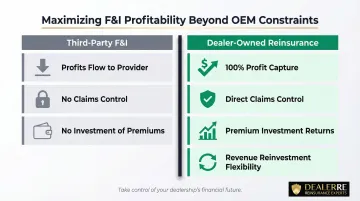
Reinsurance is the logical next step for dealers who have compliance under control and want to maximize F&I profitability.
For more information about how dealer-owned reinsurance programs can complement your OEM warranty operations, contact DealerRE at (804) 824-9533.
Frequently Asked Questions
What is OEM in warranty?
OEM stands for Original Equipment Manufacturer and in the warranty context refers to the warranty provided by the vehicle's manufacturer covering defects in materials and workmanship using genuine OEM parts and authorized repair procedures.
What does the Magnuson-Moss Warranty Act do?
The Magnuson-Moss Warranty Act is a federal law governing written warranties on consumer products. It generally prohibits manufacturers from voiding a warranty solely because an aftermarket or non-OEM part was used, unless the manufacturer can prove the non-OEM part caused the defect.
Does warranty work have to be done by the dealer?
For OEM warranties, work typically must be performed by an authorized dealer using OEM-certified technicians and genuine parts. Independent shops generally cannot perform OEM warranty repairs, though extended service contracts may have more flexibility depending on the contract terms.
Can non-OEM parts void an OEM warranty?
Non-OEM parts don't automatically void the entire OEM warranty under Magnuson-Moss, but the manufacturer can deny warranty coverage for specific components affected by the non-OEM part. Certain modifications can void coverage more broadly depending on the franchise agreement and the type of repair performed.
What happens if a dealership fails an OEM warranty compliance audit?
A failed compliance audit can result in chargebacks on previously paid claims, rejected future warranty submissions, required repayment of reimbursements, and in serious cases, franchise violations or termination.